

Recorded GPU benchmark viewer
Download Python script · Download script with helper and data files (.zip)
Recorded GPU benchmark viewer
Section titled “Recorded GPU benchmark viewer”This viewer reads a locally recorded artifact and displays any condensation or coagulation rows it contains. Saved outputs are an illustration of that artifact, not qualification of the current release or evidence of general CPU-strategy parity. Missing rows are unavailable, not zero.
Run from the repository root. The opt-in collector is:
pytest particula/gpu/tests/benchmark_test.py --benchmark -v -sThe controlled path is .artifacts/benchmarks/gpu_benchmark_results.json.
A local export with matching metadata is also accepted. Check its recorded
revision, command, Warp version, device, and workload before comparing runs.
The file is mutable and may differ from the dated evidence linked below.
It does not contain the reviewed resident/capture evidence required by the
qualification gates.
Python · section 1
import jsonfrom pathlib import Pathfrom typing import Any
import matplotlib.pyplot as plt
Load benchmark data
Section titled “Load benchmark data”Python · section 2
BENCHMARK_FILENAME = "gpu_benchmark_results.json"BENCHMARK_ARTIFACT_PATH = Path(".artifacts/benchmarks") / BENCHMARK_FILENAME

def _load_benchmark_payload(path: Path) -> dict[str, Any]:    """Load a benchmark JSON payload from disk."""    with path.open(encoding="utf-8") as handle:        payload = json.load(handle)    if not isinstance(payload, dict):        raise ValueError("benchmark payload must be a JSON object")    benchmarks = payload.get("benchmarks")    if not isinstance(benchmarks, dict):        raise ValueError("benchmark payload must include a dict benchmarks map")    return payload

def _validate_benchmark_candidate(path: Path) -> None:    """Validate that a candidate file matches the controlled benchmark schema."""    payload = _load_benchmark_payload(path)    metadata = payload.get("benchmark_metadata")    if not isinstance(metadata, dict):        raise ValueError("benchmark payload must include benchmark_metadata")    artifact_path = metadata.get("artifact_path")    if artifact_path != str(BENCHMARK_ARTIFACT_PATH):        raise ValueError(            "benchmark payload artifact_path does not match the controlled path"        )

def _find_benchmark_results() -> Path:    """Find benchmark JSON, preferring the controlled artifact path."""    current = Path.cwd().resolve()    rejected_candidates: list[str] = []
    for parent in [current, *current.parents]:        artifact_candidate = parent / BENCHMARK_ARTIFACT_PATH        if artifact_candidate.exists():            try:                _validate_benchmark_candidate(artifact_candidate)            except (OSError, json.JSONDecodeError, ValueError) as exc:                rejected_candidates.append(                    f"{artifact_candidate}: {type(exc).__name__}: {exc}"                )            else:                return artifact_candidate
        if (parent / "pyproject.toml").exists():            break
    for parent in [current, *current.parents]:        export_candidate = parent / BENCHMARK_FILENAME        if export_candidate.exists():            try:                _validate_benchmark_candidate(export_candidate)            except (OSError, json.JSONDecodeError, ValueError) as exc:                rejected_candidates.append(                    f"{export_candidate}: {type(exc).__name__}: {exc}"                )            else:                return export_candidate
        # Stop at the repo root (contains pyproject.toml)        if (parent / "pyproject.toml").exists():            break
    msg = (        "Could not find benchmark results at either "        f"{BENCHMARK_ARTIFACT_PATH} or {BENCHMARK_FILENAME}. "        "Run the benchmarks first:\n"        "  pytest particula/gpu/tests/benchmark_test.py "        "--benchmark -v -s\n"        "or copy/export the recorded artifact into the working directory."    )    if rejected_candidates:        msg += "\nRejected candidates:\n- " + "\n- ".join(rejected_candidates)    raise FileNotFoundError(msg)

results_path = _find_benchmark_results()
with open(results_path) as f:    data = json.load(f)
benchmarks = data["benchmarks"]print(f"Loaded {len(benchmarks)} benchmark entries from {results_path}")print(f"Run started: {data.get('started_at', 'unknown')}")
Loaded 2 benchmark entries from <execution-temp>/gpu_benchmark_results.json
Run started: 2026-09-06T00:12:44.409179+00:00Condensation scaling
Section titled “Condensation scaling”Python · section 3
# Parse condensation entriescond_entries = {    k: v for k, v in benchmarks.items() if k.startswith("condensation_")}
# Build table datacond_rows = []for key, entry in sorted(    cond_entries.items(),    key=lambda x: x[1]["n_boxes"] * x[1]["n_particles"],):    label = key.replace("condensation_", "")    n_total = entry["n_boxes"] * entry["n_particles"]    gpu_s = entry["gpu_time_s"]    steps = entry["steps"]    gpu_per_step = gpu_s / steps    cpu_s = entry.get("cpu_time_s")    speedup = entry.get("speedup")    cond_rows.append(        {            "label": label,            "n_boxes": entry["n_boxes"],            "n_particles": entry["n_particles"],            "total": n_total,            "gpu_s": gpu_s,            "gpu_per_step": gpu_per_step,            "cpu_s": cpu_s,            "speedup": speedup,        }    )
# Print tableprint(    f"{'Config':<12} {'Boxes':>5} {'Particles':>10} "    f"{'Total':>10} {'GPU (s)':>9} {'CPU (s)':>9} {'Speedup':>8}")print("-" * 75)for r in cond_rows:    cpu_str = f"{r['cpu_s']:.4f}" if r["cpu_s"] else "--"    spd_str = f"{r['speedup']:.1f}x" if r["speedup"] else "--"    print(        f"{r['label']:<12} {r['n_boxes']:>5} {r['n_particles']:>10,} "        f"{r['total']:>10,} {r['gpu_s']:>9.4f} {cpu_str:>9} {spd_str:>8}"    )
Config Boxes Particles Total GPU (s) CPU (s) Speedup
---------------------------------------------------------------------------Condensation GPU scaling plot
Section titled “Condensation GPU scaling plot”Python · section 4
cond_plot_rows = [    r for r in cond_rows if r["total"] > 0 and r["gpu_per_step"] > 0]if not cond_plot_rows:    print("No condensation benchmark entries found; skipping plot.")else:    fig, (ax1, ax2) = plt.subplots(1, 2, figsize=(12, 5))
    # Left: GPU time vs total particles    totals = [r["total"] for r in cond_plot_rows]    gpu_times = [r["gpu_per_step"] * 1000 for r in cond_plot_rows]  # ms    ax1.scatter(totals, gpu_times, s=50, zorder=5)    ax1.set_xscale("log")    ax1.set_yscale("log")    ax1.set_xlabel("Total particles (boxes x particles)")    ax1.set_ylabel("GPU time per step (ms)")    ax1.set_title("Condensation: GPU scaling")    ax1.grid(True, alpha=0.3)
    # Right: Speedup (where positive CPU comparison data exists)    cpu_rows = [        r        for r in cond_plot_rows        if r["speedup"] is not None and r["speedup"] > 0    ]    if cpu_rows:        labels = [r["label"] for r in cpu_rows]        speedups = [r["speedup"] for r in cpu_rows]        bars = ax2.barh(labels, speedups, color="steelblue")        ax2.set_xlabel("GPU speedup vs CPU (x)")        ax2.set_title("Condensation: GPU vs CPU speedup")        ax2.set_xscale("log")        for bar, spd in zip(bars, speedups, strict=True):            ax2.text(                bar.get_width() * 1.1,                bar.get_y() + bar.get_height() / 2,                f"{spd:.0f}x",                va="center",                fontsize=9,            )        ax2.grid(True, alpha=0.3, axis="x")    else:        ax2.axis("off")        ax2.set_title("Condensation: no CPU speedup data")
    fig.tight_layout()    plt.show()
No condensation benchmark entries found; skipping plot.Coagulation scaling
Section titled “Coagulation scaling”Python · section 5
# Parse coagulation entriescoag_entries = {    k: v for k, v in benchmarks.items() if k.startswith("coagulation_")}
coag_rows = []for key, entry in sorted(    coag_entries.items(),    key=lambda x: x[1]["n_boxes"] * x[1]["n_particles"],):    label = key.replace("coagulation_", "")    n_total = entry["n_boxes"] * entry["n_particles"]    gpu_s = entry["gpu_time_s"]    steps = entry["steps"]    gpu_per_step = gpu_s / steps    cpu_s = entry.get("cpu_time_s")    speedup = entry.get("speedup")    coag_rows.append(        {            "label": label,            "n_boxes": entry["n_boxes"],            "n_particles": entry["n_particles"],            "total": n_total,            "gpu_s": gpu_s,            "gpu_per_step": gpu_per_step,            "cpu_s": cpu_s,            "speedup": speedup,        }    )
print(    f"{'Config':<12} {'Boxes':>5} {'Particles':>10} "    f"{'Total':>10} {'GPU (s)':>9} {'CPU (s)':>9} {'Speedup':>8}")print("-" * 75)for r in coag_rows:    cpu_str = f"{r['cpu_s']:.4f}" if r["cpu_s"] else "--"    spd_str = f"{r['speedup']:.1f}x" if r["speedup"] else "--"    print(        f"{r['label']:<12} {r['n_boxes']:>5} {r['n_particles']:>10,} "        f"{r['total']:>10,} {r['gpu_s']:>9.4f} {cpu_str:>9} {spd_str:>8}"    )
Config Boxes Particles Total GPU (s) CPU (s) Speedup
---------------------------------------------------------------------------
1x500 1 500 500 1.0298 0.5287 0.5x
1x2k 1 2,000 2,000 15.9727 0.6708 0.0xCoagulation GPU scaling plot
Section titled “Coagulation GPU scaling plot”Python · section 6
coag_plot_rows = [    r for r in coag_rows if r["n_particles"] > 0 and r["gpu_per_step"] > 0]if not coag_plot_rows:    print("No coagulation benchmark entries found; skipping plot.")else:    fig, (ax1, ax2) = plt.subplots(1, 2, figsize=(12, 5))
    # Separate single-box vs multi-box for color coding    single_box = [r for r in coag_plot_rows if r["n_boxes"] == 1]    multi_box = [r for r in coag_plot_rows if r["n_boxes"] > 1]
    # Left: GPU time vs particles per box (colored by n_boxes)    for rows, color, label in [        (single_box, "tab:blue", "1 box"),        (multi_box, "tab:orange", "multi-box"),    ]:        if rows:            x = [r["n_particles"] for r in rows]            y = [r["gpu_per_step"] * 1000 for r in rows]            ax1.scatter(x, y, s=50, color=color, label=label, zorder=5)
    ax1.set_xscale("log")    ax1.set_yscale("log")    ax1.set_xlabel("Particles per box")    ax1.set_ylabel("GPU time per step (ms)")    ax1.set_title("Coagulation: GPU scaling")    ax1.legend()    ax1.grid(True, alpha=0.3)
    # Right: Speedup (where CPU data exists)    cpu_rows = [r for r in coag_plot_rows if r["speedup"] is not None]    if cpu_rows:        labels = [r["label"] for r in cpu_rows]        speedups = [r["speedup"] for r in cpu_rows]        colors = [            "tab:blue" if r["n_boxes"] == 1 else "tab:orange" for r in cpu_rows        ]        bars = ax2.barh(labels, speedups, color=colors)        ax2.set_xlabel("GPU speedup vs CPU (x)")        ax2.set_title("Coagulation: GPU vs CPU speedup")        for bar, spd in zip(bars, speedups, strict=True):            ax2.text(                bar.get_width() + 0.5,                bar.get_y() + bar.get_height() / 2,                f"{spd:.1f}x",                va="center",                fontsize=9,            )        ax2.grid(True, alpha=0.3, axis="x")    else:        ax2.axis("off")        ax2.set_title("Coagulation: no CPU speedup data")
    fig.tight_layout()    plt.show()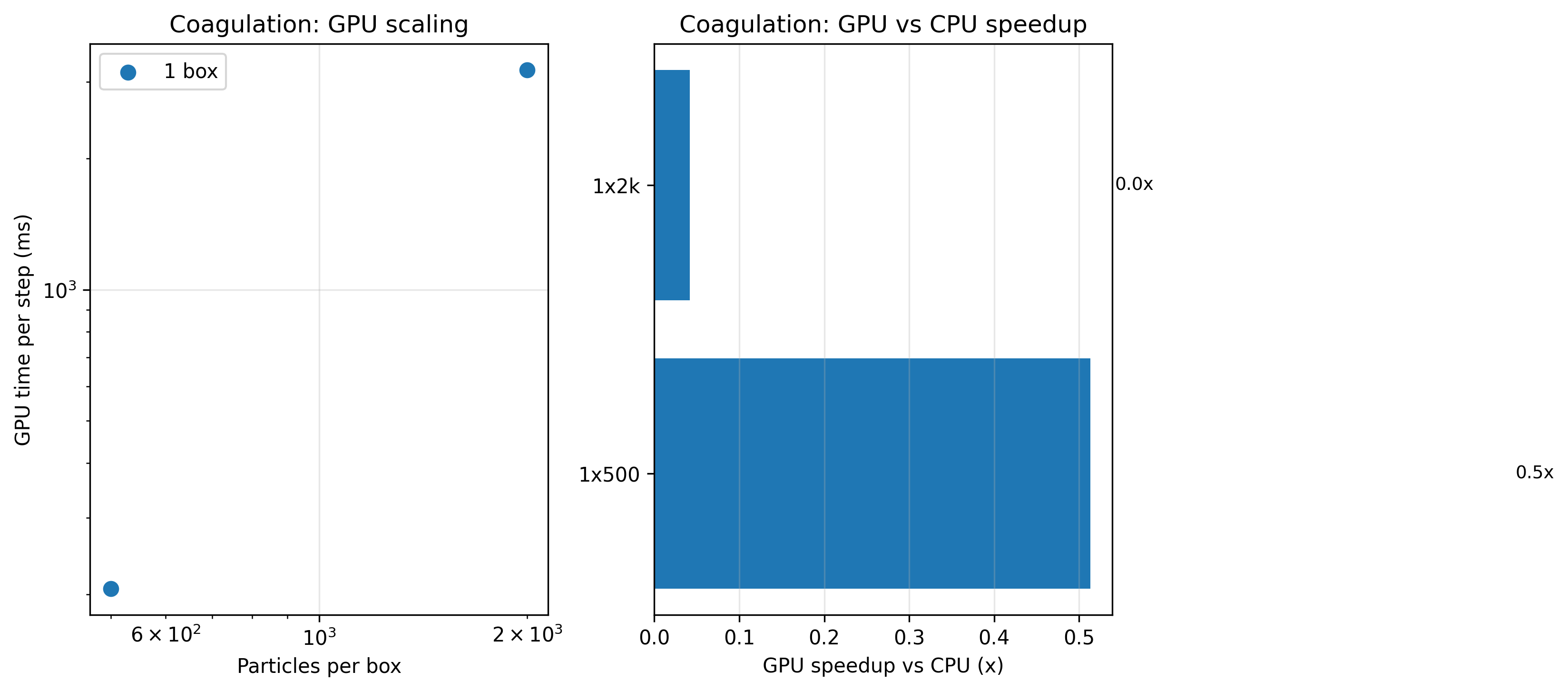
Interpreting results
Section titled “Interpreting results”Compare only rows with matching workloads, numerical methods, precision, revision, and hardware context. A kernel timing is not end-to-end throughput; explicit transfers and synchronization can change the relevant cost.
Condensation sections display data only when the loaded artifact contains those rows. They do not establish a general speedup or recommendation. Coagulation’s one-thread-per-box path can benefit from independent-box parallelism while large single-box workloads remain constrained.
See the 2026-07-10 coagulation decision record for its specific machine-bounded timings and caution band. Those historical observations are not measurements of the current v0.3.0 tree or necessarily the artifact loaded above. Current resident timing and memory qualification remains unavailable.
Explore this topic: Performance and memory evidence