

CUDA resident ownership and checkpoint restart
CUDA resident ownership and checkpoint restart
Section titled “CUDA resident ownership and checkpoint restart”What makes a saved state sufficient for restarting, rather than merely plotting? This example separates detached inspection values, canonical continuation state, and new device ownership. Use the prepared workflow for ordinary simulations; this lower-level example explains the underlying lifecycle contract.
Keep native particles, gas and environment on one device and restart
from a canonical checkpoint with new storage identities.
Run with --cuda to reproduce the saved figures. CUDA is required
for publication; unavailable hardware never becomes a successful GPU run.
Python · section 1
"""Demonstrate the bounded GPU-resident session lifecycle and checkpoints.
The optional Warp runtime and every concrete resident seam are imported only onthe enabled path. The enabled path uploads deterministic CPU carriers once,then demonstrates guard ownership, a nonterminal checkpoint, an explicitsame-device restart, and cached terminal finalization. This example does notschedule processes, launch physics, select a backend, transport state, orprovide fallback."""
from __future__ import annotations
import importlibimport osfrom dataclasses import dataclassfrom types import SimpleNamespacefrom typing import Any
import numpy as npfrom particula.gas import EnvironmentData, GasDatafrom particula.particles import ParticleData
_FORCE_NO_WARP_ENV = "PARTICULA_EXAMPLE_FORCE_NO_WARP"

@dataclassclass ExampleRun:    """Retain stable observations from the optional lifecycle demonstration.
    All enabled-only fields remain ``None`` when Warp is unavailable or disabled.
    Attributes:        output: Deterministic, address-free status lines.        session: Source resident session after the lifecycle demonstration.        registry: Resource registry bound to ``session``.        guard: Closed source step guard bound to ``session`` and ``registry``.        checkpoint: Nonterminal checkpoint captured while ``session`` is active.        restarted: Fresh ``(session, registry, guard)`` restarted binding.        terminal_checkpoint: Cached terminal checkpoint from source finalization.    """
    output: list[str]    session: Any | None = None    registry: Any | None = None    guard: Any | None = None    checkpoint: Any | None = None    restarted: tuple[Any, Any, Any] | None = None    terminal_checkpoint: Any | None = None

def _warp_enabled() -> bool:    """Return whether the optional Warp runtime is enabled and importable.
    A force-disable environment variable short-circuits before the Warp probe.    Only a missing top-level Warp installation is treated as an unavailable    optional runtime. Broken enabled imports propagate to make their failure    visible.
    Returns:        ``True`` when Warp is enabled and imports successfully; otherwise,        ``False``.    """    if os.getenv(_FORCE_NO_WARP_ENV) == "1":        return False    try:        importlib.import_module("warp")    except ModuleNotFoundError as error:        if error.name == "warp":            return False        raise    return True

def _load_enabled_runtime() -> SimpleNamespace:    """Load the enabled-only Warp and concrete resident-session modules.
    This example does not directly import ``particula.gpu``. Its concrete    ``gpu_resources`` dependency may import that package transitively.
    Returns:        Namespace containing Warp plus the resident-session types and helpers.
    Raises:        ImportError: If an enabled-only runtime dependency cannot be imported.    """    wp = importlib.import_module("warp")    execution = importlib.import_module("particula.execution")    session = importlib.import_module("particula.execution.gpu_session")    resources = importlib.import_module("particula.execution.gpu_resources")    checkpoint = importlib.import_module("particula.execution.checkpoint")    return SimpleNamespace(        wp=wp,        Backend=execution.Backend,        Device=execution.Device,        ResidentLifecycle=session.ResidentLifecycle,        setup_resident_session=session.setup_resident_session,        ResidentStepGuard=session.ResidentStepGuard,        GPUResourceRegistry=resources.GPUResourceRegistry,        restart_resident_session=checkpoint.restart_resident_session,    )

def _build_cpu_state() -> tuple[ParticleData, GasData, EnvironmentData]:    """Build native carriers holding one particle in a 1e-6 m³ volume.
    Returns:        Particle, gas, and environment carriers in that setup order.    """    particles = ParticleData(        masses=np.array([[[1.0e-18]]], dtype=np.float64),        concentration=np.array([[1.0]], dtype=np.float64),        charge=np.array([[0.0]], dtype=np.float64),        density=np.array([1000.0], dtype=np.float64),        volume=np.array([1.0e-6], dtype=np.float64),        distribution_type="particle_resolved",    )    gas = GasData(        name=["water"],        molar_mass=np.array([0.018], dtype=np.float64),        concentration=np.array([[1.0e-9]], dtype=np.float64),        partitioning=np.array([True], dtype=np.bool_),    )    environment = EnvironmentData(        temperature=np.array([298.15], dtype=np.float64),        pressure=np.array([101325.0], dtype=np.float64),        saturation_ratio=np.array([[1.0]], dtype=np.float64),    )    return particles, gas, environment

def _disabled_output() -> list[str]:    """Return deterministic, address-free status for the no-Warp path.
    Returns:        Status lines confirming that no CPU fixture or resident session exists.    """    return [        "Canonical path: docs/examples/gpu/resident/gpu_resident_session.py",        "CPU fixture: not constructed because Warp is unavailable or disabled.",        "Warp is unavailable or disabled; no resident session was created.",    ]

def run_example(device: str = "cpu") -> ExampleRun:    """Run lifecycle bookkeeping without executing a physical process.
    Enabled-loader errors intentionally propagate. The two zero-duration guard    tokens demonstrate ownership only, not scheduling or process ordering.
    Args:        device: Warp device identifier for the explicit restart target. Defaults            to Warp CPU.
    Returns:        Deterministic disabled-path status when Warp is unavailable or disabled;        otherwise, lifecycle observations for the source and restarted bindings.
    Raises:        ImportError: If an enabled-only runtime dependency cannot be imported.        RuntimeError: If the resident lifecycle rejects an invalid transition.        ValueError: If the selected device or resident state is invalid.    """    if not _warp_enabled():        return ExampleRun(output=_disabled_output())    runtime = _load_enabled_runtime()    particles, gas, environment = _build_cpu_state()    selected_device = runtime.Device(runtime.Backend.WARP, device)    session = runtime.setup_resident_session(        particles, gas, environment, selected_device    )    registry = runtime.GPUResourceRegistry(session)    guard = runtime.ResidentStepGuard(session, registry)    for _ in range(2):        token = guard.begin_step(0.0)        guard.complete_step(token)        guard.assert_step_closed()
    checkpoint = session.checkpoint(registry, guard)    assert session.lifecycle is runtime.ResidentLifecycle.ACTIVE    restarted = runtime.restart_resident_session(checkpoint, selected_device)    restarted_session, restarted_registry, restarted_guard = restarted    restarted_guard.assert_step_closed()    assert restarted_session is not session    assert restarted_registry is not registry    assert restarted_guard is not guard    assert restarted_session.particles is not session.particles    assert restarted_session.gas is not session.gas    assert restarted_session.environment is not session.environment    terminal_checkpoint = session.finalize(registry, guard)    assert session.lifecycle is runtime.ResidentLifecycle.FINALIZED    assert session.finalize(registry, guard) is terminal_checkpoint    return ExampleRun(        output=[            "Canonical path: docs/examples/gpu/resident/gpu_resident_session.py",            "Finalization terminalizes its source; returned checkpoint is ACTIVE "            "and cached.",            "Restart is explicit, same-device, and never automatic.",            "Inspection is lossy; canonical checkpoint bytes are restart authority.",            "Checkpoint schema version 5 compatibility is exact and fail-closed.",            "Exclusions: no scheduling, transport, fallback, or physics orchestration.",        ],        session=session,        registry=registry,        guard=guard,        checkpoint=checkpoint,        restarted=restarted,        terminal_checkpoint=terminal_checkpoint,    )
Verify physical state survives checkpoint and restart
Section titled “Verify physical state survives checkpoint and restart”This ownership example advances zero physical time. The equal bars are the expected result: checkpoint and restart preserve represented number and particle-plus-gas inventory. Restart creates new device allocations from canonical bytes. Use the prepared lifecycle tutorial for evolving physics.
Python · section 2
def run_publication():    """Require CUDA and visualize state preservation across ownership changes."""    import matplotlib.pyplot as plt    import warp as wp
    if not _warp_enabled() or not wp.is_cuda_available():        raise RuntimeError("This publication run requires CUDA")    initial_p, initial_g, _ = _build_cpu_state()    result = run_example(device="cuda:0")    if result.checkpoint is None or result.restarted is None:        raise RuntimeError("CUDA produced no checkpoint")    restarted, registry, guard = result.restarted    try:        wp.synchronize_device("cuda:0")        masses = restarted.particles.masses.numpy().copy()        counts = restarted.particles.concentration.numpy().copy()        gas = restarted.gas.concentration.numpy().copy()        np.testing.assert_array_equal(masses, initial_p.masses)        np.testing.assert_array_equal(counts, initial_p.concentration)        np.testing.assert_array_equal(gas, initial_g.concentration)        checkpoint = result.checkpoint        numbers = [            initial_p.concentration.sum(),            checkpoint.particles.concentration.sum(),            counts.sum(),        ]        inventories = [            np.sum(initial_p.masses * initial_p.concentration[..., None])            + np.sum(initial_g.concentration * initial_p.volume[:, None]),            np.sum(                checkpoint.particles.masses                * checkpoint.particles.concentration[..., None]            )            + np.sum(                checkpoint.gas.concentration                * checkpoint.particles.volume[:, None]            ),            np.sum(masses * counts[..., None])            + np.sum(gas * restarted.particles.volume.numpy()[:, None]),        ]    finally:        restarted.close(registry, guard)    fig, axes = plt.subplots(1, 2, figsize=(9, 3.5), constrained_layout=True)    labels = ["CPU initial", "Checkpoint", "CUDA restart"]    axes[0].bar(labels, numbers, color="#287a90")    axes[0].set(ylabel="Represented particle count")    axes[1].bar(labels, np.array(inventories) * 1e18, color="#be6c39")    axes[1].set(ylabel="Particle + gas inventory (fg)")    fig.suptitle("State preservation · " + wp.get_device("cuda:0").name)    print("\n".join(result.output))    plt.show()    return result

def main() -> None:    """Run the example and print its deterministic status lines.
    Raises:        ImportError: If an enabled-only runtime dependency cannot be imported.        RuntimeError: If the resident lifecycle rejects an invalid transition.        ValueError: If the selected device or resident state is invalid.    """    for line in run_example().output:        print(line)

if __name__ == "__main__":    import sys
    if "--cuda" in sys.argv[1:]:        run_publication()    else:        main()
Explicit cuda invocation
result = run_publication()Warp 1.11.1 initialized:
CUDA Toolkit 12.9, Driver 13.4
Devices:
"cpu" : "CPU"
"cuda:0" : "NVIDIA GeForce RTX 5060" (8 GiB, sm_120, mempool enabled)
Kernel cache:
~/.cache/warp/1.11.1
Canonical path: docs/examples/gpu/resident/gpu_resident_session.py
Finalization terminalizes its source; returned checkpoint is ACTIVE and cached.
Restart is explicit, same-device, and never automatic.
Inspection is lossy; canonical checkpoint bytes are restart authority.
Checkpoint schema version 5 compatibility is exact and fail-closed.
Exclusions: no scheduling, transport, fallback, or physics orchestration.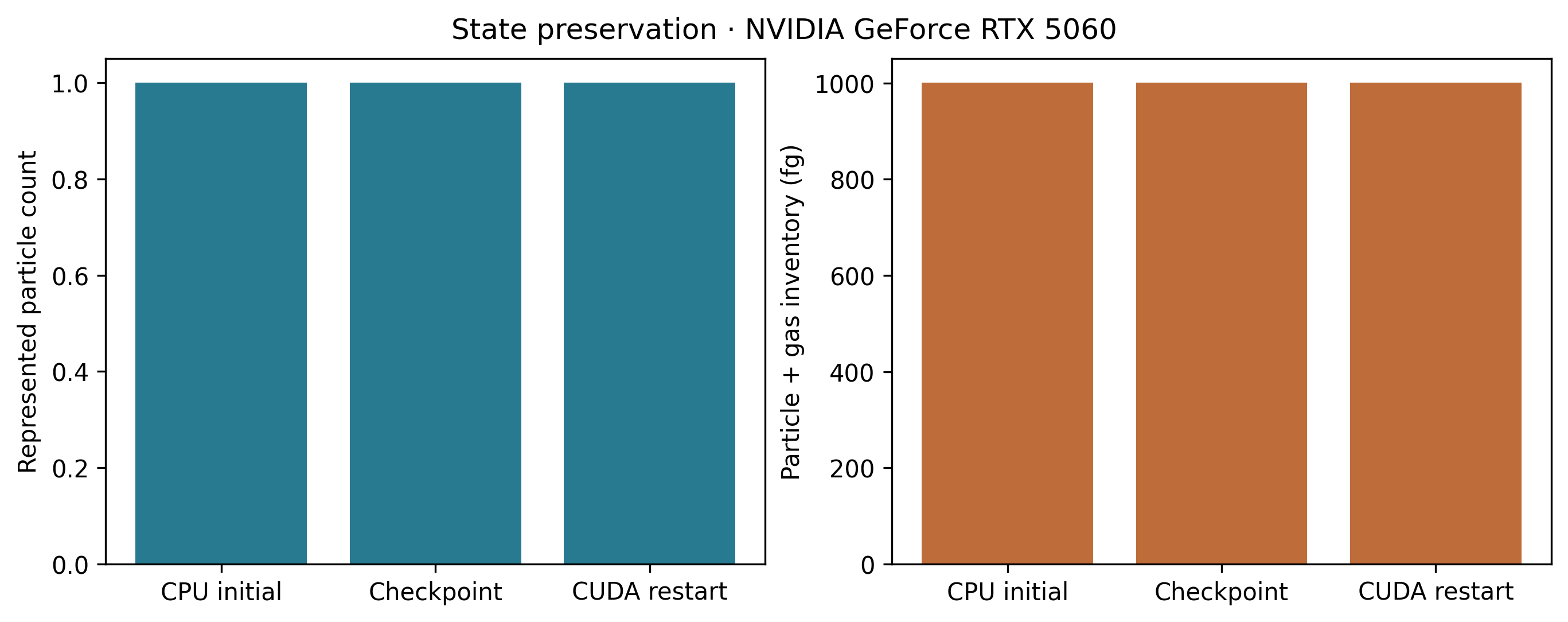
Preservation without evolution
Section titled “Preservation without evolution”Equal bars are the expected result because no physical process is launched and the two guarded steps have zero duration. The publication path also compares restored masses, counts, and gas arrays exactly. New storage identity prevents the restarted session from simply aliasing the original; it is distinct from changing the physical state.
For a long study, test restart after nonzero evolution and include random continuation and external forcing position in the comparison. A matching final mass total can conceal a different size distribution or random trajectory. The multi-timestep example adds evolving physics, while the prepared cyclic study shows why an application must retain its forcing schedule as well.
Explore this topic: Resident execution