

Qualify CUDA optics before interpreting a cloud spectrum
Qualify CUDA optics before interpreting a cloud spectrum
Section titled “Qualify CUDA optics before interpreting a cloud spectrum”When does a batch of optical calculations benefit from CUDA, and can the device calculation preserve the CPU optical quantities? This example pairs a timing study with explicit numerical comparisons, then computes extinction and angular scattering for an illustrative droplet population at four wavelengths.
Requires native CUDA, Warp, and Particula’s development optics API. CPU runs are explicit comparison oracles; there is no CPU fallback. Start with the sphere-to-cloud walkthrough for the physical quantities and the optics guide for units and reference frames.
The physics assumes independent homogeneous spheres with a fixed illustrative refractive index. Population Mueller matrices share one scattering-plane frame. This is an optical calculation, not a particle-growth or multiple-scattering radiative-transfer simulation.
Python · section 1
import time
import matplotlib.pyplot as pltimport numpy as npimport warp as wpfrom particula.optics import (    get_cross_sections,    get_differential_mueller_matrix,    get_mie_coefficients,    get_mie_efficiencies,    get_mueller_matrix,    get_population_mueller_matrix,    get_population_optics,    get_scattering_amplitudes,)from particula.optics.gpu import prepare_mie, prepare_population_mie
Separate numerical agreement from timing
Section titled “Separate numerical agreement from timing”The benchmark increases both batch size (64, 512, 2048) and maximum size parameter x (10, 100, 1000). Because both change, this is not a pure batch-size scaling experiment. Index 1.5 + 0.1i is held fixed. Upload and workspace preparation happen explicitly; warm runs reuse the output storage.
All efficiency outputs are compared with NumPy at rtol=10⁻⁸ and atol=10⁻¹². The pointer assertion checks storage reuse. Synchronization closes each timed CUDA run, while five device repetitions and three NumPy repetitions supply execution medians. Module loading, transfers, and preparation are recorded separately and excluded from the warm bars.
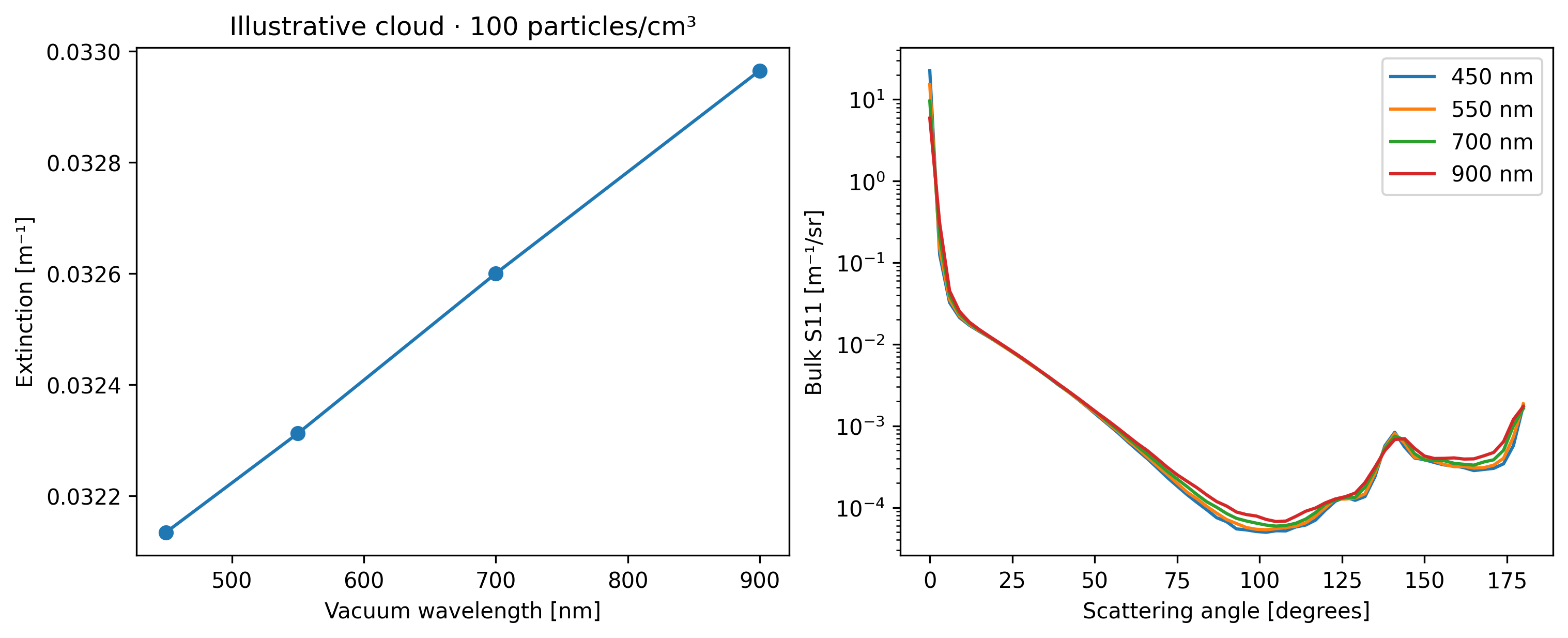
The cloud calculation uses 512 radius bins from 0.5–20 µm, four wavelengths from 450–900 nm, and 61 scattering angles. Weights sum to 10⁸ particles/m³ at each wavelength. Tiled processing retains bulk optics and differential Mueller matrices, rather than a permanent full population of angular outputs. Scalar population outputs use the same relative/absolute tolerance as particle efficiencies. Matrix errors are normalized by each wavelength’s largest reference element, then bounded absolutely by 10⁻⁸; that is not a relative error guarantee for every small matrix element.
Python · section 2
def benchmark_case(device, count, maximum_x):    """Compare every efficiency and separately time explicit pipeline stages."""    x = np.geomspace(0.1, maximum_x, count)    index = np.tile([1.5, 0.1], (count, 1))    wp.synchronize_device(device)    start = time.perf_counter()    m_device = wp.array(index, dtype=wp.vec2d, device=device)    x_device = wp.array(x, dtype=wp.float64, device=device)    wp.synchronize_device(device)    upload = time.perf_counter() - start    start = time.perf_counter()    work = prepare_mie(        m_device,        x_device,        case_tile=256,        coefficient_capacity=int(            np.ceil(maximum_x + 4.05 * np.cbrt(maximum_x) + 2)        ),    )    wp.synchronize_device(device)    preparation = time.perf_counter() - start    work.enqueue()    work.check()  # Untimed warm-up and explicit status observation.    pointer = work.efficiencies.ptr    gpu_seconds = []    for _ in range(5):        start = time.perf_counter()        work.enqueue()        wp.synchronize_device(device)        gpu_seconds.append(time.perf_counter() - start)    work.check()    assert work.efficiencies.ptr == pointer    start = time.perf_counter()    actual = work.efficiencies.numpy()    download = time.perf_counter() - start    cpu_seconds = []    for _ in range(3):        start = time.perf_counter()        expected = get_mie_efficiencies(x / (2 * np.pi), 1.0, 1.5 + 0.1j)        cpu_seconds.append(time.perf_counter() - start)    expected_array = np.stack(expected, axis=-1)    np.testing.assert_allclose(actual, expected_array, rtol=1e-8, atol=1e-12)    return {        "cases": count,        "maximum_x": maximum_x,        "upload_seconds": upload,        "preparation_seconds": preparation,        "download_seconds": download,        "gpu_seconds": gpu_seconds,        "cpu_seconds": cpu_seconds,        "maximum_absolute_efficiency_error": float(            np.max(abs(actual - expected_array))        ),    }

def cloud_spectrum(device):    """Stream four cloud spectra and verify all scalar and Mueller outputs."""    radius = np.geomspace(0.5e-6, 20e-6, 512)    wavelength = np.array([450e-9, 550e-9, 700e-9, 900e-9])    angles = np.linspace(0, np.pi, 61)    shape = (len(wavelength), len(radius))    radii = np.broadcast_to(radius, shape).copy()    x = 2 * np.pi * radii / wavelength[:, None]    distribution = np.exp(-0.5 * (np.log(radius / 6e-6) / 0.4) ** 2)    weights = np.broadcast_to(        1e8 * distribution / distribution.sum(), shape    ).copy()    indices = np.empty(shape + (2,))    indices[..., 0], indices[..., 1] = 1.33, 1e-8    work = prepare_population_mie(        wp.array(indices, dtype=wp.vec2d, device=device),        wp.array(x, dtype=wp.float64, device=device),        wp.array(radii, dtype=wp.float64, device=device),        wp.array(weights, dtype=wp.float64, device=device),        angles=wp.array(angles, dtype=wp.float64, device=device),        particle_tile=128,        angle_tile=32,        coefficient_capacity=320,    )    work.enqueue()    work.check()    bulk = work.optics.numpy()    matrix = work.mueller.numpy()    q = get_mie_efficiencies(radii, wavelength[:, None], 1.33 + 1e-8j)    expected = get_population_optics(        get_cross_sections(q, radii), q.asymmetry, weights    )    np.testing.assert_allclose(        bulk, np.stack(expected, -1), rtol=1e-8, atol=1e-12    )    amplitudes = get_scattering_amplitudes(        get_mie_coefficients(1.33 + 1e-8j, x), angles    )    differential = get_differential_mueller_matrix(        get_mueller_matrix(*amplitudes), wavelength[:, None]    )    expected_matrix = get_population_mueller_matrix(differential, weights)    scale = np.max(abs(expected_matrix), axis=(1, 2, 3))[:, None, None, None]    np.testing.assert_allclose(        matrix / scale, expected_matrix / scale, rtol=0, atol=1e-8    )    return {        "wavelength_nm": (wavelength * 1e9).tolist(),        "extinction_m_inv": bulk[:, 0].tolist(),        "absorption_m_inv": bulk[:, 2].tolist(),        "asymmetry": bulk[:, 6].tolist(),        "angle_degrees": np.rad2deg(angles).tolist(),        "differential_scattering_m_inv_sr": matrix[:, :, 0, 0].tolist(),        "maximum_scaled_mueller_error": float(            np.max(abs(matrix - expected_matrix) / scale)        ),    }

def simulate():    """Execute the full native-CUDA study with explicit CPU qualification."""    wp.init()    if not wp.is_cuda_available():        raise RuntimeError("This example requires native CUDA")    device = wp.get_device("cuda:0")    module_times = {}    for name in ("mie", "angular", "_bulk"):        start = time.perf_counter()        wp.load_module(module=f"particula.optics.gpu.{name}", device=device)        wp.synchronize_device(device)        module_times[name] = time.perf_counter() - start    return {        "device": device.name,        "warp_version": wp.__version__,        "module_compile_or_cache_load_seconds": module_times,        "benchmarks": [            benchmark_case(device, n, x)            for n, x in [(64, 10.0), (512, 100.0), (2048, 1000.0)]        ],        "cloud": cloud_spectrum(device),    }

def plot_results(report):    """Plot compact saved timings and cloud optics without CUDA execution."""    cases = report["benchmarks"]    labels = [f"{v['cases']} cases\nx ≤ {v['maximum_x']:g}" for v in cases]    position = np.arange(len(cases))    fig, ax = plt.subplots(figsize=(8, 4), constrained_layout=True)    for offset, key, label in [        (-0.18, "cpu_seconds", "NumPy CPU"),        (0.18, "gpu_seconds", "CUDA, warm"),    ]:        median = [np.median(v[key]) for v in cases]        ax.bar(position + offset, median, width=0.36, label=label)    ax.set(        xticks=position,        xticklabels=labels,        yscale="log",        ylabel="Median execution time [s]",        title=report["device"],    )    ax.legend()    cloud = report["cloud"]    fig, axes = plt.subplots(1, 2, figsize=(10, 4), constrained_layout=True)    axes[0].plot(cloud["wavelength_nm"], cloud["extinction_m_inv"], marker="o")    axes[0].set(        xlabel="Vacuum wavelength [nm]",        ylabel="Extinction [m⁻¹]",        title="Illustrative cloud · 100 particles/cm³",    )    for wave, values in zip(        cloud["wavelength_nm"],        cloud["differential_scattering_m_inv_sr"],        strict=True,    ):        axes[1].semilogy(cloud["angle_degrees"], values, label=f"{wave:g} nm")    axes[1].set(xlabel="Scattering angle [degrees]", ylabel="Bulk S11 [m⁻¹/sr]")    axes[1].legend()    print("Device:", report["device"], "Warp", report["warp_version"])    print(        "Module compile/cache load [s]:",        report["module_compile_or_cache_load_seconds"],    )    for row in cases:        print(            f"{row['cases']} cases, x≤{row['maximum_x']:g}: "            f"upload={row['upload_seconds']:.6g}s, "            f"prepare={row['preparation_seconds']:.6g}s, "            f"download={row['download_seconds']:.6g}s, "            f"max Q error={row['maximum_absolute_efficiency_error']:.3g}"        )    print(        "All particle efficiencies and full bulk Mueller matrices pass "        "the declared CPU/CUDA comparisons."    )    return report

def run_example():    """Execute the complete study and render its observations."""    return plot_results(simulate())
Read the saved timing and optical evidence
Section titled “Read the saved timing and optical evidence”The timing bars compare warm synchronized CUDA execution with the NumPy CPU implementation on the recorded machine. They do not include full one-shot cost or establish universal speedups. Use the separately printed upload, preparation, and download times when judging a workflow that cannot reuse device inputs.
In the cloud panels, extinction is a bulk coefficient in m⁻¹, while S11 is angle-dependent scattering in m⁻¹/sr. The strong forward peak shows why a single extinction coefficient cannot describe the directional signal. The 61-angle grid samples that structure; finer angular convergence would be needed to resolve a narrow peak for a particular instrument. Fixed refractive index makes the wavelength comparison a size-parameter effect in this model.
The checks qualify CPU/CUDA agreement for these cases. They do not test the homogeneous-sphere assumption against measured cloud scattering.
Python · section 3
if __name__ == "__main__": result = run_example() plt.show()Explicit cuda invocation
result = run_example()Warp 1.11.1 initialized:
CUDA Toolkit 12.9, Driver 13.4
Devices:
"cpu" : "CPU"
"cuda:0" : "NVIDIA GeForce RTX 5060" (8 GiB, sm_120, mempool enabled)
Kernel cache:
/tmp/optics-stream-evidence-cache/warp/1.11.1Module particula.optics.gpu.mie 36c0414 load on device 'cuda:0' took 531.82 ms (compiled)Module particula.optics.gpu.angular 91aee41 load on device 'cuda:0' took 501.12 ms (compiled)Module particula.optics.gpu._bulk 8686aab load on device 'cuda:0' took 445.49 ms (compiled)Device: NVIDIA GeForce RTX 5060 Warp 1.11.1
Module compile/cache load [s]: {'mie': 0.600302426959388, 'angular': 0.5027199620380998, '_bulk': 0.4470886969938874}
64 cases, x≤10: upload=0.000408508s, prepare=0.000428676s, download=2.2652e-05s, max Q error=1.55e-15
512 cases, x≤100: upload=0.000135982s, prepare=0.000155299s, download=3.1438e-05s, max Q error=2e-15
2048 cases, x≤1000: upload=0.000237081s, prepare=0.000453121s, download=6.3468e-05s, max Q error=5.33e-15
All particle efficiencies and full bulk Mueller matrices pass the declared CPU/CUDA comparisons.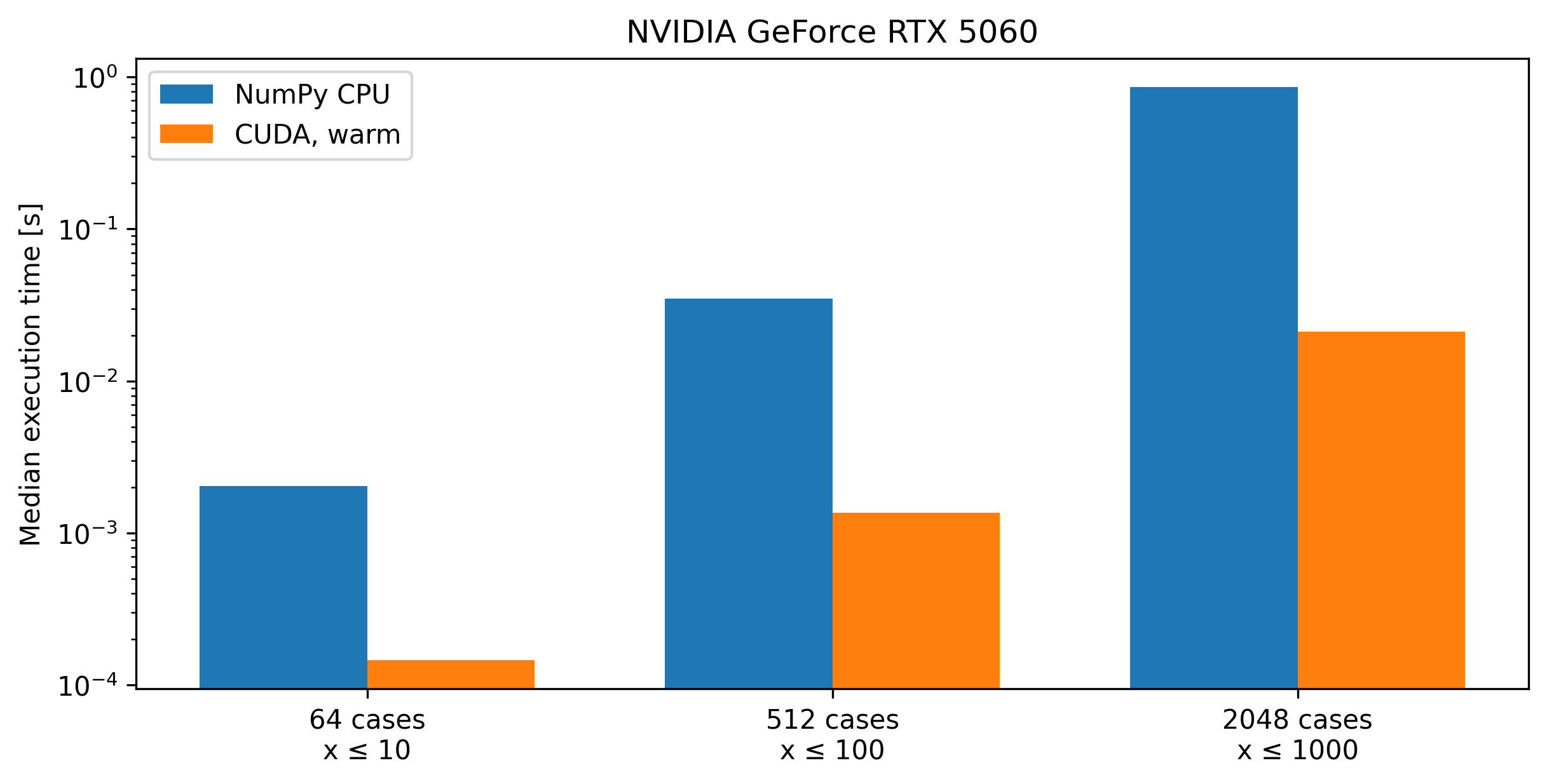
Choose the next comparison deliberately
Section titled “Choose the next comparison deliberately”CUDA can reuse prepared storage while reproducing the tested CPU optical quantities. Whether that helps a research workflow depends on batch size, size parameter, repeated use, transfers, and the requested angular outputs.
For a controlled performance study, fix the size-parameter range and vary only batch size, reporting both warm and full-pipeline times. For a scientific study, vary the droplet size distribution at fixed number density and compare spectral extinction and angle-resolved S11 with observations. Use measured refractive indices and convergence checks; device agreement alone cannot validate those physical inputs or an instrument’s viewing geometry.
Explore this topic: Optical properties · GPU workflows