

Follow a source marker through collisions and removal
Follow a source marker through collisions and removal
Section titled “Follow a source marker through collisions and removal”Can a tracer still tell you where particle material came from after particles merge or storage is resampled? This CPU example registers an additive per-particle marker and checks its represented inventory, Σ nᵢ qᵢ. The marker is dimensionless and extensive per physical particle; it is not a material species and does not change aerosol physics.
The first case combines actual Brownian mergers with dilution. It uses 256 particles with radii 20–80 nm, number density 10¹⁵ m⁻³, and an alternating 0/1 tag. The high abundance makes mergers observable in a short 15 s calculation. Merging adds partner tags; dilution at 0.03 s⁻¹ changes counts and records the removed inventory while preserving each survivor’s per-particle tag.
The second, independent case forces fixed-capacity resampling during nucleation and assigns newborn tags. Read represented counts and bounded sources first. These cases check CPU bookkeeping; they make no CPU/GPU stochastic-trajectory claim.
Python · section 1
"""Registered particle-field inventory and redistribution examples."""
import matplotlib.pyplot as pltimport numpy as npfrom particula import Aerosol, FieldSpecfrom particula.dynamics import (    ActivationNucleationBuilder,    BrownianCoagulationStrategy,    Coagulation,    Dilution,    DilutionStrategy,    Nucleation,    NucleationCommitConfig,    NucleationSourceConfig,)from particula.dynamics.nucleation.species_mapping import NucleationSpeciesMapfrom particula.execution import CPUExecutionContextfrom particula.gas import EnvironmentData, GasDatafrom particula.particles import ParticleDatafrom particula.particles.exhaustion import ExhaustionControlsfrom particula.util.constants import AVOGADRO_NUMBER
TAG = "demo.tag"

def state(masses, counts, volume, gas_concentration):    """Construct fixed-capacity resolved state with precursor and inert gas."""    return Aerosol(        particles=ParticleData(            masses=np.asarray(masses, dtype=float).reshape(1, -1, 1),            concentration=np.asarray(counts, dtype=float).reshape(1, -1),            charge=np.zeros((1, len(counts))),            density=np.array([1000.0]),            volume=np.array([volume]),            distribution_type="particle_resolved",        ),        gas=GasData(            name=["precursor", "inert"],            molar_mass=np.array([0.2, 0.029]),            concentration=np.array([[gas_concentration, 1e-6]]),            partitioning=np.array([True, False]),        ),        environment=EnvironmentData(            temperature=np.array([298.15]),            pressure=np.array([101325.0]),            saturation_ratio=np.ones((1, 2)),        ),    )

def tag_inventory(aerosol):    """Independently compute represented tag equivalents in one box."""    return float(np.sum(aerosol.particles.concentration * aerosol.fields[TAG]))

def coagulation_case():    """Follow nonzero mergers and count removal without losing tag accounting."""    slots = 256    radius = np.geomspace(20e-9, 80e-9, slots)    masses = 4 * np.pi / 3 * 1000 * radius**3    aerosol = state(masses, np.ones(slots), slots / 1e15, 0.0)    tags = (np.arange(slots) % 2 == 0).astype(float)[None, :]    aerosol.fields.add(        FieldSpec(            TAG, ("box", "particle"), "1", particle_policy="additive", minimum=0        ),        tags,    )    initial_inventory = tag_inventory(aerosol)    process = Coagulation(BrownianCoagulationStrategy("particle_resolved"))    process = process | Dilution(DilutionStrategy(0.03))    context = CPUExecutionContext(root_seed=47, box_ids=("chamber",))    times = np.arange(31) * 0.5    inventories, removals, active = [initial_inventory], [0.0], [slots]    for time in times[:-1]:        process.execute(aerosol, 0.5, time=float(time), context=context)        inventory = tag_inventory(aerosol)        ledger = aerosol.fields.inventory_changes(TAG)        removed = float(ledger["removal"][0])        np.testing.assert_allclose(            inventory + removed, initial_inventory, rtol=2e-13        )        np.testing.assert_array_equal(ledger["source"], 0)        inventories.append(inventory)        removals.append(removed)        active.append(int(np.count_nonzero(aerosol.particles.concentration)))    assert active[-1] < slots, "the example must contain actual mergers"    np.testing.assert_allclose(        inventories, initial_inventory * np.exp(-0.03 * times), rtol=2e-13    )    mask = aerosol.particles.concentration[0] > 0    np.testing.assert_array_equal(aerosol.fields[TAG][0, ~mask], 0)    # Save compact weighted histograms, not full particle trajectories.    edges = np.arange(0, int(aerosol.fields[TAG].max()) + 2) - 0.5    histogram, _ = np.histogram(        aerosol.fields[TAG][0, mask],        bins=edges,        weights=aerosol.particles.concentration[0, mask],    )    initial_histogram, _ = np.histogram(tags[0], bins=edges)    return dict(        time=times.tolist(),        inventory=inventories,        removal=removals,        active=active,        initial_inventory=initial_inventory,        edges=edges.tolist(),        initial_histogram=initial_histogram.tolist(),        final_histogram=histogram.tolist(),    )
Resampling and births have different meanings
Section titled “Resampling and births have different meanings”Three unit-count particles carry tags 10, 20 and 40. Only one slot is free, but the source needs two unit-count newborn slots. Resampling represents the three old particles with two count-1.5 survivors. Equal particle masses make the native sort order deterministic here. Its exact count-interval overlaps give (10 + 0.5×20)/1.5 and (0.5×20 + 40)/1.5 tag units per survivor. Each newborn receives 7 tag units from the field’s birth default.
The field ledger therefore records 14 added tag units, while native gas and particle mass conserve the mapped material independently. These arbitrary tag units are not molecular mass. Resampling preserves represented tag inventory, but can change the joint size/tag distribution. Equal-count GPU coagulation must not be applied to the resulting unequal survivor/newborn counts without satisfying its separate admission contract; these are separate examples.
Python · section 2
def source_case():    """Check exact redistribution, birth defaults and native material balance."""    aerosol = state(        [1e-20, 1e-20, 1e-20, 0], [1, 1, 1, 0], 1.0, 8 * 0.2 / AVOGADRO_NUMBER    )    aerosol.fields.add(        FieldSpec(            TAG,            ("box", "particle"),            "1",            particle_policy="additive",            initial_value=7,        ),        np.array([[10.0, 20.0, 40.0, 0.0]]),    )    strategy = (        ActivationNucleationBuilder()        .set_parameters(            {                "coefficient": 0.25,                "coefficient_units": "s^-1",                "coefficient_provenance": "illustrative fixed-capacity source",                "precursor_number_concentration_lower": 0.0,                "precursor_number_concentration_lower_units": "1/m^3",                "precursor_number_concentration_upper": 1e30,                "precursor_number_concentration_upper_units": "1/m^3",                "temperature_lower": 200.0,                "temperature_lower_units": "K",                "temperature_upper": 400.0,                "temperature_upper_units": "K",                "injection_composition": [1, 0],                "formation_diameter": 1.0,                "formation_diameter_units": "nm",            }        )        .build()    )    process = Nucleation(        NucleationSourceConfig(            strategy,            0,            NucleationSpeciesMap(tuple(aerosol.gas.name), ((0, 0),)),        ),        NucleationCommitConfig(            maximum_slot_weight=1.0,            source_charge=0.0,            exhaustion_controls=ExhaustionControls(True, False),            requested_scale=np.ones(1),            minimum_scale=np.ones(1),            minimum_volume=np.array([0.1]),            radius_cubed_relative_error=0.01,        ),    )
    def material_inventory():        p = aerosol.particles        return float(            np.sum(p.masses[..., 0] * p.concentration)            + aerosol.gas.concentration[0, 0] * p.volume[0]        )
    before = material_inventory()    initial_tags = aerosol.fields[TAG].copy()    process.execute(aerosol, 1.0)    np.testing.assert_allclose(        aerosol.particles.concentration, [[1.5, 1.5, 1, 1]], rtol=1e-14    )    np.testing.assert_allclose(        aerosol.fields[TAG], [[40 / 3, 100 / 3, 7, 7]], rtol=1e-14    )    np.testing.assert_allclose(tag_inventory(aerosol), 84, rtol=1e-14)    ledger = aerosol.fields.inventory_changes(TAG)    np.testing.assert_allclose(ledger["source"], [14], rtol=1e-14)    np.testing.assert_array_equal(ledger["removal"], 0)    np.testing.assert_allclose(        material_inventory(), before, rtol=1e-12, atol=1e-30    )    return dict(        before=initial_tags[0].tolist(),        after=aerosol.fields[TAG][0].tolist(),        counts=aerosol.particles.concentration[0].tolist(),        inventory=tag_inventory(aerosol),        added=float(ledger["source"][0]),    )

def passive_rejection():    """Undefined label merging rejects without changing caller state."""    aerosol = state([1e-20, 2e-20], [1, 1], 1e-12, 0.0)    aerosol.fields.add(        FieldSpec("demo.label", ("box", "particle"), "1", dtype="int32"),        np.array([[1, 2]], dtype=np.int32),    )    before = aerosol.particles.masses.copy()    process = Coagulation(BrownianCoagulationStrategy("particle_resolved"))    try:        process.execute(aerosol, 1.0)    except ValueError as error:        assert "additive" in str(error)    else:        raise AssertionError("passive labels unexpectedly merged")    np.testing.assert_array_equal(aerosol.particles.masses, before)    np.testing.assert_array_equal(aerosol.fields["demo.label"], [[1, 2]])

def simulate():    """Run separate collision/removal and resampling/source accounting cases."""    passive_rejection()    return dict(coagulation=coagulation_case(), source=source_case())
Read three different accounting views
Section titled “Read three different accounting views”The first panel tests inventory closure under removal. The second shows how mergers change tag amount per particle; its vertical axis is represented count, not a normalized probability. The third shows per-particle tag values in storage slots after resampling and births. Multiply by the displayed case’s counts (1.5, 1.5, 1, 1) before summing that panel into an inventory.
passive_rejection separately verifies that a label with no additive policy
is rejected without changing particle masses or labels. The following renderer
is called by run_example after these scientific checks.
Python · section 3
def plot_results(report):    """Show inventory closure, changed distributions and explicit source tags."""    coag, source = report["coagulation"], report["source"]    fig, axes = plt.subplots(1, 3, figsize=(13, 4), constrained_layout=True)    axes[0].plot(coag["time"], coag["inventory"], label="In-box inventory")    axes[0].plot(coag["time"], coag["removal"], label="Removed inventory")    axes[0].plot(        coag["time"],        np.asarray(coag["inventory"]) + coag["removal"],        "k--",        label="Sum (initial inventory)",    )    axes[0].set(        xlabel="Time (s)",        ylabel="Represented tag equivalents",        title="Coagulation + dilution",    )    axes[1].stairs(coag["initial_histogram"], coag["edges"], label="Initial")    axes[1].stairs(coag["final_histogram"], coag["edges"], label="Final")    axes[1].set(        xlabel="Tag units per particle",        ylabel="Represented count",        title="Mergers change the distribution",    )    slots = np.arange(4)    axes[2].bar(slots - 0.18, source["before"], 0.36, label="Before source")    axes[2].bar(slots + 0.18, source["after"], 0.36, label="After source")    axes[2].set(        xlabel="Storage slot",        ylabel="Tag units per particle",        title="Resampling then two births",        xticks=slots,    )    for ax in axes:        ax.legend(fontsize=8)        ax.grid(alpha=0.2)    plt.show()

def run_example():    """Execute all scientific checks and render their compact saved outputs."""    report = simulate()    print("Tracer inventory, exact resampling and passive rejection passed.")    print(        "Active slots after coagulation:", report["coagulation"]["active"][-1]    )    print(        "Source inventory: 70 +",        report["source"]["added"],        "=",        report["source"]["inventory"],    )    plot_results(report)    return report

if __name__ == "__main__":    run_example()
Explicit cpu invocation
report = run_example()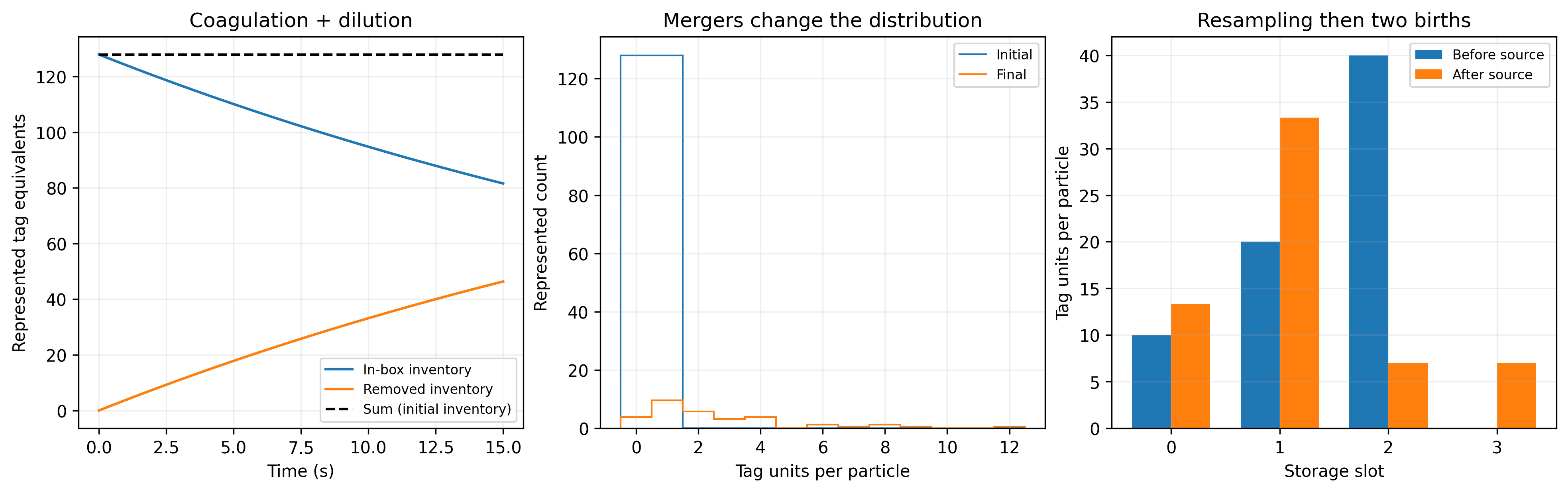
Preserve an inventory without overinterpreting a label
Section titled “Preserve an inventory without overinterpreting a label”The first case checks that retained plus removed tag inventory equals the initial 128 units, and that retained inventory follows the analytic dilution factor. The second gives 70 old tag units plus 14 newborn units, totaling 84. Those are separate experiments; their inventories must not be combined.
This establishes additive-field accounting and a controlled resampling example, not preservation of every size–tag correlation. To adapt the tracer to source mixing, tag two initial sources and compare tag fraction conditional on size before and after mergers. Vary resampling pressure and stochastic realization to determine whether an inferred mixing trend survives changes in representation. A categorical source name needs an explicit merging rule; the passive-label rejection shows why arbitrary labels cannot be silently added.
Explore this topic: Custom processes and fields