

Resolve growth as a finite vapor reservoir is depleted
Resolve growth as a finite vapor reservoir is depleted
Section titled “Resolve growth as a finite vapor reservoir is depleted”A mass-conserving update can move vapor into particles too quickly. Here a closed population of 100 nm organic particles consumes an initially abundant vapor reservoir. Compare coarse and refined fixed steps with adaptive RK23 and ROS2 using an independently written scalar growth equation. Radius and remaining vapor test accuracy; their sum tests a separate mass budget.
This idealized isothermal calculation uses one material, unit activity, constant vapor pressure, and Kelvin curvature. There is no coagulation, wall loss, source, latent heating, or claim of a measured organic compound. Number density is 10¹¹ m⁻³ in a 10⁻⁶ m³ representative volume. All methods use identical initial conditions and output times. An optional CUDA companion exercises the same reference and error targets on the actual device.
Python · section 1
from dataclasses import asdict
import matplotlib.pyplot as pltimport numpy as npimport particula as parfrom particula.dynamics.condensation.species_mapping import (    CondensationSpeciesMap,)from particula.execution.condensation_ode import CondensationODEfrom scipy.integrate import solve_ivp
CONFIGURATION = {    "radius_m": 100e-9,    "number_m3": 1e11,    "volume_m3": 1e-6,    "density_kg_m3": 1400.0,    "molar_mass_kg_mol": 0.18,    "temperature_K": 298.15,    "pressure_Pa": 101325.0,    "diffusion_m2_s": 5e-6,    "surface_tension_N_m": 0.03,    "vapor_pressure_Pa": 1e-5,    "initial_vapor_kg_m3": 1e-6,}TIMES = np.linspace(0, 10, 21)

def build_case():    """Declare the same closed native state for every numerical method."""    c = CONFIGURATION    mass = 4 * np.pi * c["density_kg_m3"] * c["radius_m"] ** 3 / 3    particles = par.particles.create_resolved_particle_data(        masses=[mass],        density=c["density_kg_m3"],        concentration=[c["number_m3"] * c["volume_m3"]],        volume=c["volume_m3"],    )    gas = par.gas.GasData(        name=["organic"],        molar_mass=np.array([c["molar_mass_kg_mol"]]),        concentration=np.array([[c["initial_vapor_kg_m3"]]]),        partitioning=np.array([True]),    )    environment = par.gas.EnvironmentData(        temperature=[c["temperature_K"]],        pressure=[c["pressure_Pa"]],        saturation_ratio=[[0.0]],    )    strategy = par.dynamics.CondensationIsothermal(        molar_mass=gas.molar_mass,        diffusion_coefficient=c["diffusion_m2_s"],        accommodation_coefficient=1.0,        activity_strategy=par.particles.ActivityIdealMass(),        surface_strategy=par.particles.SurfaceStrategyVolume(            surface_tension=c["surface_tension_N_m"],            density=c["density_kg_m3"],        ),        vapor_pressure_strategy=par.gas.ConstantVaporPressureStrategy(            c["vapor_pressure_Pa"]        ),        species_map=CondensationSpeciesMap(("organic",), ((0, 0),)),    )    return par.Aerosol(        particles=particles, gas=gas, environment=environment    ), strategy
Let x=(r/r₀)³ be particle mass divided by initial mass m₀. Conservation gives C(x)=C₀−N m₀(x−1). The diffusion equation is dx/dt=3 D f(Kn) r [C(x)−C_sat exp(A/r)]/(ρ r₀³), with A=2 σ M/(R T ρ) and unit-accommodation correction f(Kn)=0.75(1+Kn)/(Kn²+1.283 Kn+0.75). The reference below writes these relations directly and cross-checks DOP853 against Radau. It does not call Particula’s rate, activity, radius, or gas-budget helpers. The constants are specified explicitly to make this an independent implementation check.
Python · section 2
def reference(method):    """Solve the independently specified scalar mass-ratio equation."""    c = CONFIGURATION    temperature, pressure = c["temperature_K"], c["pressure_Pa"]    molar, density = c["molar_mass_kg_mol"], c["density_kg_m3"]    radius0 = c["radius_m"]    gas_constant = 8.31446261815324    mass0 = 4 * np.pi * density * radius0**3 / 3    viscosity = (        1.716e-5        * (temperature / 273.15) ** 1.5        * 383.55        / (temperature + 110.4)    )    path = (2 * viscosity / pressure) / np.sqrt(        8 * molar / (np.pi * gas_constant * temperature)    )    kelvin = (        2        * c["surface_tension_N_m"]        * molar        / (gas_constant * temperature * density)    )    saturated = c["vapor_pressure_Pa"] * molar / (gas_constant * temperature)
    def rate(time, values):        ratio = values[0]        radius = radius0 * np.cbrt(ratio)        vapor = c["initial_vapor_kg_m3"] - c["number_m3"] * mass0 * (ratio - 1)        kn = path / radius        correction = 0.75 * (1 + kn) / (kn**2 + 1.283 * kn + 0.75)        return [            3            * c["diffusion_m2_s"]            * radius            * correction            * (vapor - saturated * np.exp(kelvin / radius))            / (density * radius0**3)        ]
    solution = solve_ivp(        rate,        (0, TIMES[-1]),        [1.0],        method=method,        t_eval=TIMES,        rtol=1e-11,        atol=1e-13,    )    assert solution.success, solution.message    ratio = solution.y[0]    return np.column_stack(        (            radius0 * np.cbrt(ratio),            c["initial_vapor_kg_m3"] - c["number_m3"] * mass0 * (ratio - 1),        )    )

def calculate(method, *, tolerance=1e-5, fixed_step=0.5, device=None):    """Advance full physical intervals; snapshots are explicit GPU downloads."""    state, strategy = build_case()    owner = None    if method != "fixed":        controls = dict(            rtol=tolerance,            particle_atol=1e-28,            gas_atol=1e-16,            first_step=0.01,            max_step=0.5,        )        if device is None:            owner = CondensationODE(state, strategy, method=method, **controls)        else:            from particula.execution.gpu_condensation_ode import (                GPUCondensationODE,            )
            owner = GPUCondensationODE(                state, strategy, device=device, **controls            )    rows = []    fixed_steps = 0    budget_error = 0.0    c = CONFIGURATION    total0 = (        c["number_m3"] * state.particles.masses[0, 0, 0]        + state.gas.concentration[0, 0]    )    for index, time in enumerate(TIMES):        if index:            if owner is None:                duration = float(time - TIMES[index - 1])                substeps = int(np.ceil(duration / fixed_step))                par.dynamics.MassCondensation(strategy).execute(                    state,                    time_step=duration,                    sub_steps=substeps,                )                fixed_steps += substeps            else:                while owner.time < time:                    owner.step(float(time))                state = owner.snapshot()        mass = state.particles.masses[0, 0, 0]        gas = state.gas.concentration[0, 0]        radius = np.cbrt(3 * mass / (4 * np.pi * c["density_kg_m3"]))        rows.append([radius, gas])        budget_error = max(            budget_error, abs(c["number_m3"] * mass + gas - total0) / total0        )    assert budget_error < 2e-12, budget_error    work = (        {"fixed_steps": fixed_steps}        if owner is None        else asdict(owner.statistics if device else owner.solver.statistics)    )    return np.asarray(rows), budget_error, work

def simulate(device=None):    """Compare observable errors, reference uncertainty and closed budgets."""    expected = reference("DOP853")    independent = reference("Radau")    np.testing.assert_allclose(independent[:, 0], expected[:, 0], rtol=2e-10)    np.testing.assert_allclose(        independent[:, 1], expected[:, 1], rtol=2e-8, atol=1e-15    )    profiles = [        ("Fixed 0.5 s", "fixed", 1e-5, 0.5, None),        ("Fixed 0.005 s", "fixed", 1e-5, 0.005, None),        ("CPU RK23 1e-4", "rk23", 1e-4, 0.5, None),        ("CPU RK23 1e-7", "rk23", 1e-7, 0.5, None),        ("CPU ROS2 1e-5", "ros2", 1e-5, 0.5, None),    ]    if device is not None:        profiles.extend(            (                ("CUDA RK23 1e-4", "rk23", 1e-4, 0.5, device),                ("CUDA RK23 1e-7", "rk23", 1e-7, 0.5, device),            )        )    results = {}    for name, method, tolerance, step, backend in profiles:        values, budget, work = calculate(            method, tolerance=tolerance, fixed_step=step, device=backend        )        radius_error = float(np.max(np.abs(values[:, 0] / expected[:, 0] - 1)))        vapor_error = float(            np.max(np.abs(values[:, 1] - expected[:, 1]))            / CONFIGURATION["initial_vapor_kg_m3"]        )        if method != "fixed":            assert radius_error < 2e-4, (name, radius_error)            assert vapor_error < 1e-3, (name, vapor_error)        results[name] = {            "radius_nm": (values[:, 0] * 1e9).tolist(),            "vapor_ug_m3": (values[:, 1] * 1e9).tolist(),            "radius_error": radius_error,            "vapor_error": vapor_error,            "budget_error": budget,            "work": work,        }    for coarse, fine in (        ("Fixed 0.5 s", "Fixed 0.005 s"),        ("CPU RK23 1e-4", "CPU RK23 1e-7"),    ):        for observable in ("radius_error", "vapor_error"):            assert results[fine][observable] < results[coarse][observable]    if device is not None:        for observable in ("radius_error", "vapor_error"):            assert (                results["CUDA RK23 1e-7"][observable]                < results["CUDA RK23 1e-4"][observable]            )    return {        "configuration": CONFIGURATION,        "time_s": TIMES.tolist(),        "reference_radius_nm": (expected[:, 0] * 1e9).tolist(),        "reference_vapor_ug_m3": (expected[:, 1] * 1e9).tolist(),        "results": results,    }

def plot_results(report):    """Render compact saved histories and separate error/work diagnostics."""    fig, axes = plt.subplots(1, 2, figsize=(11, 4), layout="constrained")    for axis, key, ylabel in zip(        axes,        ("radius_nm", "vapor_ug_m3"),        ("Radius (nm)", "Vapor (µg m⁻³)"),        strict=True,    ):        axis.plot(            report["time_s"],            report[f"reference_{key}"],            color="black",            linewidth=2,            label="Independent reference",        )        for name, result in report["results"].items():            axis.plot(                report["time_s"],                result[key],                label=name,                linestyle="--",                alpha=0.8,            )        axis.set(xlabel="Time (s)", ylabel=ylabel)    axes[0].legend(fontsize=7)    for name, result in report["results"].items():        print(            name,            "radius error:",            result["radius_error"],            "vapor error / initial vapor:",            result["vapor_error"],            "mass residual:",            result["budget_error"],            "work:",            result["work"],        )    return fig
The plotted transient tests when vapor is transferred, not only the final total. Tightening a fixed timestep or adaptive tolerance should reduce both radius and vapor errors. The vapor error is normalized by initial vapor so an almost depleted denominator cannot exaggerate a tiny absolute difference. Work counters explain the accuracy cost without treating unequal CPU/GPU timings as a speedup. In the retained CPU comparison, reducing the fixed step from 0.5 s to 0.005 s reduces the maximum radius error from 1.31% to 0.0122%. RK23 at relative tolerance 10⁻⁷ reaches a radius error of 2.57×10⁻⁸ with 430 accepted steps; the initial-vapor-normalized error is 9.15×10⁻⁸. ROS2 also meets the targets but takes 2,574 accepted steps at tolerance 10⁻⁵. This nonstiff case therefore does not justify choosing a stiff method solely because it is available. For a new compound, change its declared properties and repeat this comparison before adding collisions, forcing, or thermal feedback.
Python · section 3
if __name__ == "__main__": report = simulate() figure = plot_results(report) plt.show()Explicit cpu invocation
report = simulate()figure = plot_results(report)Fixed 0.5 s radius error: 0.013104491968154663 vapor error / initial vapor: 0.051724928104230926 mass residual: 1.3348093070485667e-16 work: {'fixed_steps': 20}
Fixed 0.005 s radius error: 0.00012153195858566335 vapor error / initial vapor: 0.00047126688190263693 mass residual: 5.339237228194267e-16 work: {'fixed_steps': 2000}
CPU RK23 1e-4 radius error: 1.820119292772482e-05 vapor error / initial vapor: 6.736678437977377e-05 mass residual: 4.0044279211457e-16 work: {'accepted': 62, 'rejected': 1, 'domain_rejected': 0, 'rate_calls': 252, 'jacobian_calls': 0, 'time_derivative_calls': 0, 'factorizations': 0, 'linear_solves': 0}
CPU RK23 1e-7 radius error: 2.573387414273043e-08 vapor error / initial vapor: 9.152069530558079e-08 mass residual: 8.0088558422914e-16 work: {'accepted': 430, 'rejected': 2, 'domain_rejected': 0, 'rate_calls': 1728, 'jacobian_calls': 0, 'time_derivative_calls': 0, 'factorizations': 0, 'linear_solves': 0}
CPU ROS2 1e-5 radius error: 7.743971802698368e-07 vapor error / initial vapor: 2.8580766376794065e-06 mass residual: 2.2691758219825635e-15 work: {'accepted': 2574, 'rejected': 1, 'domain_rejected': 0, 'rate_calls': 5150, 'jacobian_calls': 2575, 'time_derivative_calls': 2575, 'factorizations': 2575, 'linear_solves': 15450}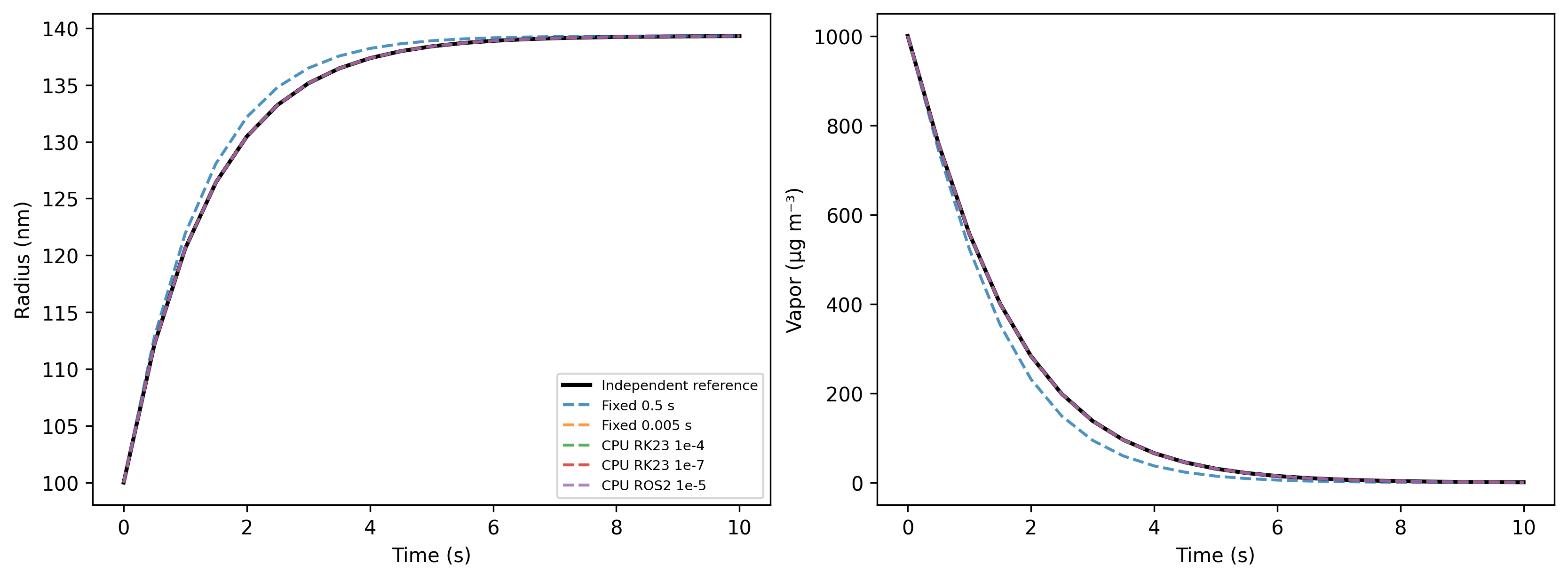
Explore this topic: Adaptive growth and relaxation