

Direct Brownian coagulation on CUDA
Direct Brownian coagulation on CUDA
Section titled “Direct Brownian coagulation on CUDA”How can number fall while particle material remains in the box? Follow the count-weighted inventory through two collision calls, including inactive slots that retain old values. This is a useful bridge from resolved CPU coagulation to direct device execution.
Six active particles and two inactive slots make the bookkeeping visible:
collisions reduce particle number while preserving represented mass and
charge. The same random stream and collision storage survive both calls.
Run with --cuda to reproduce the published figures. The unflagged command
retains the small Warp CPU regression; large stochastic ensembles are shown
in the prepared simulation studies.
Python · section 1
"""Run selected-adapter GPU coagulation with explicit CPU-to-Warp transfers.
This standalone example demonstrates the bounded, low-level,particle-resolved Brownian coagulation path. It defaults to Warp ``device="cpu"``and reuses caller-owned collision and RNG sidecars for two concreteselected-adapter dispatches before explicitly restoring CPU particle data. Ithas no hidden CPU fallback, Runnable API, CUDA requirement, restart/checkpointsupport, or performance claim.
"""
from __future__ import annotations
import importlibimport osfrom dataclasses import dataclassfrom typing import Any
import numpy as npfrom particula.particles import ParticleData
_FORCE_NO_WARP_ENV = "PARTICULA_EXAMPLE_FORCE_NO_WARP"

@dataclassclass ExampleRun:    """Store metadata and optional outputs from selected-adapter dispatch.
    All optional fields are ``None`` when Warp is unavailable or disabled.
    Attributes:        output: Deterministic, human-readable execution metadata.        particle_data: CPU particle data restored after both selected dispatches.        collision_pairs: Caller-owned collision-pair sidecar.        n_collisions: Caller-owned per-box collision-count sidecar.        rng_states: Caller-owned persistent RNG sidecar.    """
    output: list[str]    particle_data: ParticleData | None = None    collision_pairs: Any | None = None    n_collisions: Any | None = None    rng_states: Any | None = None

def _build_particle_data() -> ParticleData:    """Create six unit-count particles in 1e-18 m³ and two inactive slots.
    Inactive material/charge is deliberately retained to demonstrate that    coagulation ignores zero-count slots. These are not canonical free slots    suitable for nucleation or activation.
    Returns:        Eight particle slots with six active particles and two inactive slots.    """    return ParticleData(        masses=np.array(            [                [                    [1.0e-21],                    [1.3e-21],                    [1.7e-21],                    [2.2e-21],                    [2.8e-21],                    [3.5e-21],                    [0.0],                    [4.0e-21],                ]            ],            dtype=np.float64,        ),        concentration=np.array(            [[1.0, 1.0, 1.0, 1.0, 1.0, 1.0, 0.0, 0.0]],            dtype=np.float64,        ),        charge=np.array(            [[1.0, -1.0, 2.0, -2.0, 0.0, 3.0, -3.0, 4.0]],            dtype=np.float64,        ),        density=np.array([1000.0], dtype=np.float64),        volume=np.array([1.0e-18], dtype=np.float64),        distribution_type="particle_resolved",    )

def _warp_enabled() -> bool:    """Return whether optional Warp execution is available and enabled.
    Returns:        ``True`` unless Warp is unavailable or the force-no-Warp flag is set.    """    if os.getenv(_FORCE_NO_WARP_ENV) == "1":        return False    warp_available, _, _ = _load_gpu_helpers()    return warp_available

def _load_gpu_helpers() -> tuple[bool, Any, Any]:    """Lazily load GPU availability and explicit particle-transfer helpers.
    Returns:        Warp availability, CPU-to-Warp conversion, and Warp-to-CPU restoration        helpers in that order.    """    gpu = importlib.import_module("particula.gpu")    return (        gpu.WARP_AVAILABLE,        gpu.to_warp_particle_data,        gpu.from_warp_particle_data,    )

def _load_gpu_runtime() -> tuple[Any, Any, Any, Any, Any]:    """Lazily load Warp and concrete selected-Brownian adapter classes.
    Returns:        Warp, the Brownian marker, Warp state, execution state, and execution        adapter classes in that order.    """    wp = importlib.import_module("warp")    coagulation = importlib.import_module(        "particula.execution.adapters.coagulation"    )    return (        wp,        coagulation.BrownianCoagulationConfig,        coagulation.WarpBrownianCoagulationState,        coagulation.WarpBrownianCoagulationExecutionState,        coagulation.WarpBrownianCoagulationExecutionAdapter,    )

def _admitted_timestep(particles: Any, capacity: int) -> float:    """Inspect compact work demand before each explicit collision step."""    from particula.gpu.kernels.coagulation import coagulation_preflight_gpu
    report = coagulation_preflight_gpu(        particles, 298.15, 101325.0, 1.0, max_collisions=capacity    )    limits = report["max_time_step"]    positive = limits[limits > 0]    return float(positive.min()) * (1 - 1e-8) if positive.size else 0.0

def _output_prefix(particle_data: ParticleData) -> list[str]:    """Build deterministic metadata describing the CPU fixture."""    return [        "Canonical path: docs/examples/gpu/direct/gpu_coagulation_direct.py",        (            "ParticleData constructed: "            f"masses={particle_data.masses.shape}, "            f"concentration={particle_data.concentration.shape}, "            f"charge={particle_data.charge.shape}, "            f"density={particle_data.density.shape}, "            f"volume={particle_data.volume.shape}"        ),    ]

def run_example(device: str = "cpu") -> ExampleRun:    """Run two selected-Brownian calls with persistent caller-owned sidecars.
    The enabled route transfers the CPU fixture explicitly, executes the    concrete-only selected adapter twice, synchronizes once, and restores a CPU    particle data only after both calls succeed. Failures from runtime loading,    conversion, allocation, execution, synchronization, or restoration    propagate without a success result.
    Args:        device: Warp device for the optional selected path. Defaults to Warp CPU.
    Returns:        Metadata only when disabled, otherwise the restored particle data and        caller-owned sidecars.    """    particle_data = _build_particle_data()    output = _output_prefix(particle_data)    if not _warp_enabled():        output.append("Warp is unavailable or disabled; no kernel ran.")        return ExampleRun(output=output)
    _, to_warp_particle_data, from_warp_particle_data = _load_gpu_helpers()    (        wp,        config_type,        state_type,        execution_state_type,        adapter_type,    ) = _load_gpu_runtime()    gpu_particle_data = to_warp_particle_data(particle_data, device=device)    n_boxes = particle_data.n_boxes    collision_capacity = max(1, particle_data.n_particles // 2)    collision_pairs = wp.zeros(        (n_boxes, collision_capacity, 2), dtype=wp.int32, device=device    )    n_collisions = wp.zeros((n_boxes,), dtype=wp.int32, device=device)    rng_states = wp.zeros((n_boxes,), dtype=wp.uint32, device=device)    adapter = adapter_type()    for initialize_rng in (True, False):        timestep = _admitted_timestep(gpu_particle_data, collision_capacity)        state = state_type(            config_type(),            gpu_particle_data,            298.15,            101325.0,            timestep,            volume=gpu_particle_data.volume,            collision_pairs=collision_pairs,            n_collisions=n_collisions,            rng_states=rng_states,            rng_seed=41,            initialize_rng=initialize_rng,        )        result = adapter.execute(execution_state_type(state))        backend_result = result.backend_result.value        collision_pairs = backend_result.collision_pairs        n_collisions = backend_result.n_collisions    wp.synchronize()    restored_particle_data = from_warp_particle_data(        gpu_particle_data, sync=False    )    # Resolved concentration is a count, so extensive species mass has no    # extra volume factor. Do not count material in zero-count inactive slots.    np.testing.assert_allclose(        np.sum(            restored_particle_data.masses            * restored_particle_data.concentration[:, :, None],            axis=1,        ),        np.sum(            particle_data.masses * particle_data.concentration[:, :, None],            axis=1,        ),        rtol=1e-12,        atol=1e-30,    )    output.extend(        [            "Explicit helpers: CPU→Warp conversion -> selected-adapter dispatch -> CPU restoration",            (                "Selected Brownian coagulation complete: "                f"device={device}, calls=2, collision_pairs="                f"{collision_pairs.shape}, n_collisions={n_collisions.shape}"            ),            (                "Final particle data restored: "                f"particle_masses={restored_particle_data.masses.shape}"            ),            "Adapter result retains supplied collision and RNG sidecars by identity.",            "Persistent RNG state is initialized once and reused by the second call.",        ]    )    return ExampleRun(        output=output,        particle_data=restored_particle_data,        collision_pairs=collision_pairs,        n_collisions=n_collisions,        rng_states=rng_states,    )
Inspect the changed size distribution
Section titled “Inspect the changed size distribution”Histogram weights are represented counts divided by physical box volume. Inactive slots contribute nothing, even if they retain old mass values. A single six-particle realization illustrates merging; it is not an estimate of ensemble variability or a throughput benchmark.
Python · section 2
def run_publication():    """Require CUDA and show particle-number change alongside conserved mass."""    import matplotlib.pyplot as plt    import warp as wp
    if not _warp_enabled() or not wp.is_cuda_available():        raise RuntimeError("This publication run requires CUDA")    initial = _build_particle_data()    result = run_example(device="cuda:0")    final = result.particle_data    if final is None:        raise RuntimeError("CUDA produced no particle snapshot")    fig, axes = plt.subplots(1, 2, figsize=(9, 3.6), constrained_layout=True)    edges = np.geomspace(1, 30, 16)    for data, label in ((initial, "Initial"), (final, "After two calls")):        volume = np.sum(data.masses / data.density, axis=2)[0]        radius = np.cbrt(3 * volume / (4 * np.pi)) * 1e9        histogram, _ = np.histogram(            radius, bins=edges, weights=data.concentration[0] / data.volume[0]        )        axes[0].stairs(histogram, edges, label=label, linewidth=2)    axes[0].set(        xscale="log",        xlabel="Radius (nm)",        ylabel="Number density per bin (m$^{-3}$)",    )    axes[0].legend()    initial_mass = np.sum(initial.masses * initial.concentration[..., None])    final_mass = np.sum(final.masses * final.concentration[..., None])    fraction = [        final.concentration.sum() / initial.concentration.sum(),        final_mass / initial_mass,    ]    axes[1].bar(        ["Represented number", "Represented mass"],        fraction,        color=["#be6c39", "#287a90"],    )    axes[1].axhline(1, color="0.5", linestyle="--")    axes[1].set(ylabel="Final / initial", ylim=(0, 1.1))    fig.suptitle("Brownian collisions · " + wp.get_device("cuda:0").name)    print("\n".join(result.output))    plt.show()    return result

def main() -> None:    """Run the example and print metadata only after successful execution."""    for line in run_example().output:        print(line)

if __name__ == "__main__":    import sys
    if "--cuda" in sys.argv[1:]:        run_publication()    else:        main()
Explicit cuda invocation
result = run_publication()Warp 1.11.1 initialized:
CUDA Toolkit 12.9, Driver 13.4
Devices:
"cpu" : "CPU"
"cuda:0" : "NVIDIA GeForce RTX 5060" (8 GiB, sm_120, mempool enabled)
Kernel cache:
<checkout>-cache/warp/1.11.1Module particula.gpu.kernels.environment e11375e load on device 'cuda:0' took 190.85 ms (compiled)Module particula.gpu.kernels.coagulation 84ae354 load on device 'cuda:0' took 252.24 ms (compiled)
Module particula.gpu.kernels._coagulation_native f93a244 load on device 'cuda:0' took 90.89 ms (compiled)Module particula.gpu.kernels._brownian_parallel eb4ead5 load on device 'cuda:0' took 1922.16 ms (compiled)Module particula.gpu.kernels._brownian_parallel 5d7e673 load on device 'cuda:0' took 3907.33 ms (compiled)
Module particula.gpu.kernels._coagulation_budget b4a3978 load on device 'cuda:0' took 183.17 ms (compiled)Module particula.gpu.kernels._brownian_parallel fb55880 load on device 'cuda:0' took 6858.83 ms (compiled)Module particula.gpu.kernels.coagulation fd5b5c9 load on device 'cuda:0' took 465.37 ms (compiled)Module particula.gpu.kernels.coagulation 79e9aa8 load on device 'cuda:0' took 529.66 ms (compiled)
Canonical path: docs/examples/gpu/direct/gpu_coagulation_direct.py
ParticleData constructed: masses=(1, 8, 1), concentration=(1, 8), charge=(1, 8), density=(1,), volume=(1,)
Explicit helpers: CPU→Warp conversion -> selected-adapter dispatch -> CPU restoration
Selected Brownian coagulation complete: device=cuda:0, calls=2, collision_pairs=(1, 4, 2), n_collisions=(1,)
Final particle data restored: particle_masses=(1, 8, 1)
Adapter result retains supplied collision and RNG sidecars by identity.
Persistent RNG state is initialized once and reused by the second call.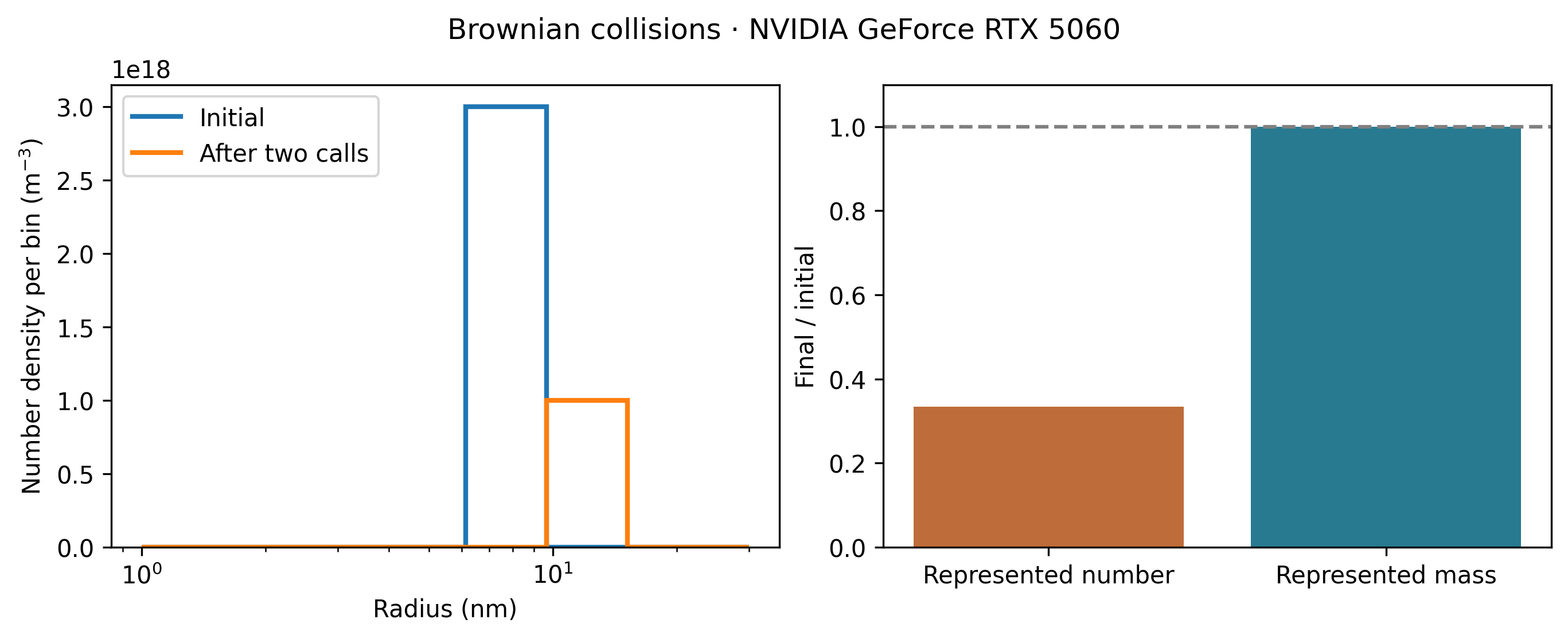
Separate a collision example from a population forecast
Section titled “Separate a collision example from a population forecast”The number-to-initial bar and mass-to-initial bar answer different questions: mergers reduce represented number while the explicit assertion preserves count-weighted material mass. Initial charge is carried through the Brownian calculation, but it does not select a charged collision kernel; this example’s assertion checks mass, not a separate charge budget.
The 10⁻¹⁸ m³ box contains only six active particles. Each call explicitly chooses a resource-admitted timestep from the current pair demand. These calls illustrate storage and stochastic continuation rather than a resolved kinetic history. For a research comparison, vary timestep and independent seeds, check charge as well as each material inventory, and compare distributions with the stochastic ensemble. Reinitializing the random stream at every call would change that experiment.
Explore this topic: Direct kernels