

Charge-dependent Brownian collisions on CUDA
Charge-dependent Brownian collisions on CUDA
Section titled “Charge-dependent Brownian collisions on CUDA”If two collision formulas agree on a GPU, does that make them the same physical model? Here you will separate implementation agreement from model disagreement by holding the dimensionless inputs fixed. The charged coagulation examples connect these inputs to particle size and charge.
A charged Brownian kernel is a complete collision model, not a correction to add to the ordinary Brownian rate. This example compares the five existing Particula models using the same diffusive Knudsen number and Coulomb potential. Positive potential means attraction; negative means repulsion. Dimensional rates also include Coulomb enhancement factors.
We evaluate the dimensionless fits on CUDA and compare every point with the NumPy implementation. Agreement establishes numerical implementation parity, not atmospheric accuracy or interchangeability of the fits. Ions require separate attachment and recombination validation.
Python · section 1
"""Compare all five charge-dependent collision fits on a real CUDA device."""
import matplotlib.pyplot as pltimport numpy as npimport warp as wpfrom particula.dynamics.coagulation import charged_dimensionless_kernel as cpufrom particula.gpu.dynamics.coagulation_funcs import charged_dimensionless_wp

@wp.kerneldef evaluate(    model: wp.int32,    knudsen: wp.array(dtype=wp.float64),    potential: wp.array(dtype=wp.float64),    hard_sphere: wp.array(dtype=wp.float64),    result: wp.array(dtype=wp.float64),):    """Evaluate concrete device functions without host-side fallback."""    i = wp.tid()    result[i] = charged_dimensionless_wp(        model, knudsen[i], potential[i], hard_sphere[i]    )
Compare the fitted transition regimes
Section titled “Compare the fitted transition regimes”The panels hold potential fixed and sweep the diffusive Knudsen number. All calculations use double precision. The non-attractive branches follow each published implementation’s convention; the dimensionless curves alone must not be interpreted as physical repulsive collision rates.
Dyachkov’s nearly neutral expression is evaluated with cancellation-resistant differences. Its analytic limit is tested independently in the package.
Python · section 2
def run_example(): """Verify CUDA parity and plot model differences across three potentials.""" if not wp.is_cuda_available(): raise RuntimeError("This example requires CUDA; no CPU fallback") models = [ ("Hard sphere", None), ("Dyachkov 2007", cpu.get_coulomb_kernel_dyachkov2007), ("Gatti 2008", cpu.get_coulomb_kernel_gatti2008), ("Gopalakrishnan 2012", cpu.get_coulomb_kernel_gopalakrishnan2012), ("Chahl 2019", cpu.get_coulomb_kernel_chahl2019), ] kn = np.logspace(-2, 2, 160) hard = cpu.get_hard_sphere_kernel(kn) device = "cuda:0" kn_gpu = wp.array(kn, dtype=wp.float64, device=device) hard_gpu = wp.array(hard, dtype=wp.float64, device=device) result = wp.empty(kn.size, dtype=wp.float64, device=device) fig, axes = plt.subplots(1, 3, figsize=(12, 4), constrained_layout=True) maximum_error = 0.0 for ax, phi in zip(axes, [-1.0, 0.0, 5.0], strict=True): potentials = np.full_like(kn, phi) phi_gpu = wp.array(potentials, dtype=wp.float64, device=device) for model_id, (name, function) in enumerate(models): wp.launch( evaluate, dim=kn.size, inputs=[model_id, kn_gpu, phi_gpu, hard_gpu, result], device=device, ) observed = result.numpy() expected = hard if function is None else function(kn, potentials) np.testing.assert_allclose(observed, expected, rtol=1e-10, atol=0) maximum_error = max( maximum_error, float(np.max(np.abs(observed / expected - 1))) ) ax.loglog(kn, observed, label=name) ax.set( xlabel="Diffusive Knudsen number", ylabel="Dimensionless kernel H", title=f"Coulomb potential = {phi:g}", ) axes[-1].legend(fontsize=8) fig.suptitle("Charged Brownian models · verified CUDA evaluations") print(f"Device: {wp.get_device(device).name}") print(f"Maximum relative CPU/CUDA difference: {maximum_error:.3e}") print("Parity is numerical evidence, not atmospheric validation.") return {"maximum_relative_error": maximum_error}Use a model in a prepared simulation
Section titled “Use a model in a prepared simulation”Construct Coagulation(ChargedCoagulationStrategy( 'particle_resolved', CoulombGatti2008KernelStrategy())), then use its usual
prepare, run, snapshot, capture and checkpoint/resume methods.
Equal positive active counts are required throughout the run. The model
selection is frozen at preparation and checked on restart.
The direct interface accepts CoagulationMechanismConfig( mechanisms=('charged_hard_sphere',), charged_model='gatti2008').
The historical mechanism identifier remains for compatibility; the explicit
model field selects its charged fit. Existing additive requests retain their
original meaning and should not be used to double-count Brownian collisions.
References and scope
Section titled “References and scope”- D’yachkov et al. (2007), Physics of Plasmas 14, 042102: flux matching with a collisionless layer for grain charging.
- Gatti and Kortshagen (2008), Physical Review E 78, 046402: a charging model across collisionality regimes.
- Gopalakrishnan and Hogan (2012), Physical Review E 85, 026410: the hard-sphere fit in equation (5), charged dimensionless scaling, and comparisons with the earlier charging models. Particula’s Gatti expression follows this continuum-consistent formulation rather than independently reimplementing the original plasma model.
- Chahl and Gopalakrishnan (2019), Aerosol Science and Technology 53, 933–957: high-potential, near-free-molecular Coulombic collision modeling.
These sources distinguish model assumptions and regimes. CPU/CUDA parity verifies the port of Particula’s formulas, including their existing branch conventions; it does not validate all five fits for atmospheric small ions.
Python · section 3
if __name__ == "__main__": run_example()Explicit cuda invocation
result = run_example()Warp 1.11.1 initialized:
CUDA Toolkit 12.9, Driver 13.4
Devices:
"cpu" : "CPU"
"cuda:0" : "NVIDIA GeForce RTX 5060" (8 GiB, sm_120, mempool enabled)
Kernel cache:
/tmp/particula-charged-warpModule particula_docs_example 3af101d load on device 'cuda:0' took 465.91 ms (compiled)
Device: NVIDIA GeForce RTX 5060
Maximum relative CPU/CUDA difference: 1.258e-13
Parity is numerical evidence, not atmospheric validation.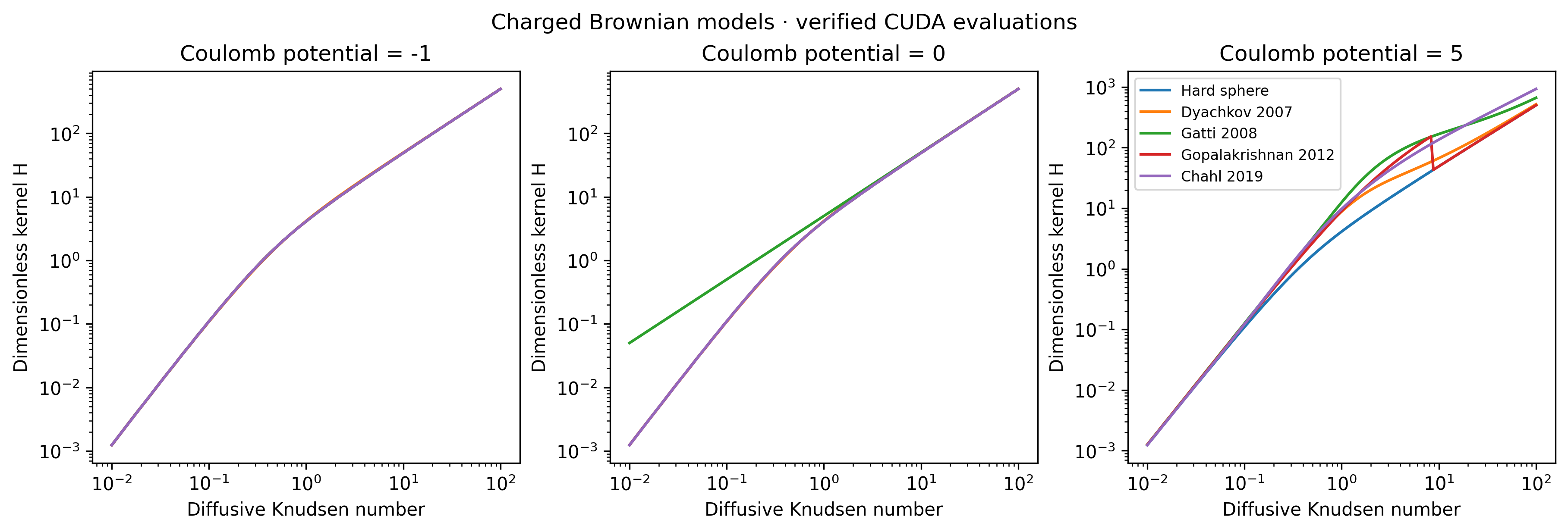
Turn model spread into a research comparison
Section titled “Turn model spread into a research comparison”The overlaid fits reveal where model choice matters even when CPU and CUDA implementations agree within the asserted tolerance. In particular, a shared non-attractive branch in these dimensionless expressions is not evidence that physical repulsion has no effect; the dimensional construction still matters.
For a charged-aerosol study, map the actual size, charge, temperature, and pressure range into these coordinates before choosing a fit. Compare dimensional kernels and population evolution for plausible alternatives, respecting each source’s regime. Use ion balance if charges must evolve through attachment, rather than assuming that a collision fit also models charging.
Explore this topic: Charged particles and ions · GPU workflows