

Repeated source pulses in a cooling and warming aerosol
Download Python script · Download script with helper and data files (.zip)
Repeated source pulses in a cooling and warming aerosol
Section titled “Repeated source pulses in a cooling and warming aerosol”What must be saved to reproduce a simulation driven by repeated external pulses? This example separates the evolving aerosol from the forcing schedule and its source ledger. Start with the prepared quick start and refined forcing example before using this larger composition and restart demonstration.
This longer illustration evolves 196,608 initially active particles in 32 boxes for 600 one-second steps. Each box has 8,192 slots, a polydisperse water/dry-material population and three gas species. Nucleation, Brownian coagulation retain their fixed one-second event schedule. Water condensation uses adaptive ROS3 between those boundaries. Event buffers and random streams persist; condensation handoff stays in device memory. Adaptive acceptance, rejection and step-size decisions run in a native CUDA conditional graph. The host schedules fixed events and observations. Condensation error control does not bound splitting or stochastic error, so this remains an illustrative chamber calculation rather than a timestep-converged prediction.
Every 50 seconds, a finite precursor pulse creates exactly 128 unit-count, neutral particles per box. Remaining precursor is explicitly removed after that step. Temperature cycles over a 200-second period, with different box offsets; water-vapor replacements at the start of each cycle add or remove mass explicitly. The source composition is the existing illustrative one-precursor-molecule nucleus, not a calibrated nucleation mechanism.
This schedule intentionally omits dilution: all active multiplicities remain one, including later injected cohorts, satisfying native Brownian admission. Every observed box must conserve each mapped species after accounting for the actual prescribed gas exchanges. Charge must remain unchanged. A checkpoint halfway through must reproduce the full final state when the same external forcing schedule is continued from its saved step index.
This is a deliberate manual CUDA study, excluded from CI execution. Its refresh permits up to four hours; download the ZIP for all study helpers.
Python · section 1
"""Longer coupled CUDA aerosol evolution with cyclic forcing and source pulses."""
import matplotlib.pyplot as pltimport numpy as npimport warp as wpfrom particula.execution.gpu_coupled import GPUCoupledSimulationfrom particula.execution.gpu_coupled_restart import resume_coupledfrom particula.util.constants import AVOGADRO_NUMBER, GAS_CONSTANTfrom scripts.gpu_studies.cases import (    StudyCase,    build_case,    radius_histogram,    water_pressure,)from scripts.gpu_studies.validation import (    mapped_inventory,    state_hash,    valid_state,)
STEPS = 600PULSE_EVERY = 50EVENTS_PER_BOX = 128

def frame(owner, step):    """Observe a detached distribution and reduced box diagnostics."""    snapshot = owner.snapshot()    diagnostics = owner.diagnostics()    edges, histogram = radius_histogram(snapshot)    return {        "time": step,        "number": diagnostics.number_concentration.tolist(),        "temperature": diagnostics.temperature.tolist(),        "saturation": diagnostics.saturation_ratio[:, 2].tolist(),        "edges": edges.tolist(),        "histogram": histogram.tolist(),    }, snapshot

def advance(owner, start, stop, initial, expected, *, observe):    """Apply the same explicit external schedule on original and resumed owners."""    boxes = initial.particles.n_boxes    frames = []    max_error = 0.0    initial_charge = np.sum(        initial.particles.charge * initial.particles.concentration, axis=1    )    for step in range(start, stop):        if step % 10 == 0:            phase = (step % 200) / 200            temperature = np.interp(                phase, [0, 0.3, 0.7, 1], [293, 278, 305, 293]            )            owner.update_environment(                temperature=temperature + np.linspace(-5, 5, boxes)            )        pulse = step % PULSE_EVERY == 0        if pulse:            data = owner.diagnostics()            # Prescribed source demand, not a download/re-upload of evolving gas.            precursor = (                4                * EVENTS_PER_BOX                * initial.gas.molar_mass[1]                / AVOGADRO_NUMBER                / initial.particles.volume            )            ratios = {}            if step % 200 == 0:                ratios[initial.gas.name[2]] = (1.4, 0.7, 1.2)[step // 200]            owner.update_gas_species(                {initial.gas.name[1]: precursor}, saturation_ratios=ratios            )            forced = owner.diagnostics()            if ratios:                # Independent observation audit; this CPU result is never uploaded.                target = (                    ratios[initial.gas.name[2]]                    * water_pressure(data.temperature)                    * initial.gas.molar_mass[2]                    / (GAS_CONSTANT * data.temperature)                )                np.testing.assert_allclose(                    forced.gas_concentration[:, 2], target, rtol=2e-14                )            for gas_lane, material in ((2, 0), (1, 1)):                expected[:, material] += (                    forced.gas_concentration[:, gas_lane]                    - data.gas_concentration[:, gas_lane]                ) * data.volume        owner.step()        if pulse:            # Only nucleation consumes this precursor. Its observed depletion            # independently verifies the unit-event demand through public data.            before_precursor = precursor.copy()            data = owner.diagnostics()            consumed_molecules = (                (before_precursor - data.gas_concentration[:, 1])                * data.volume                * AVOGADRO_NUMBER                / initial.gas.molar_mass[1]            )            np.testing.assert_allclose(                consumed_molecules, EVENTS_PER_BOX, rtol=2e-12, atol=0            )            expected[:, 1] -= data.gas_concentration[:, 1] * data.volume            owner.update_gas_species({initial.gas.name[1]: 0.0})        if observe and ((step + 1) % 20 == 0 or step + 1 == stop):            observation, snapshot = frame(owner, step + 1)            actual = mapped_inventory(snapshot)            np.testing.assert_allclose(actual, expected, rtol=2e-12, atol=1e-30)            np.testing.assert_allclose(                np.sum(                    snapshot.particles.charge                    * snapshot.particles.concentration,                    axis=1,                ),                initial_charge,                rtol=0,                atol=1e-12,            )            active = snapshot.particles.concentration            np.testing.assert_array_equal(active[active > 0], 1.0)            valid_state(snapshot)            max_error = max(                max_error, float(np.max(np.abs(actual / expected - 1)))            )            frames.append(observation)            print(f"Verified CUDA chamber t={step + 1} s", flush=True)    return frames, max_error
Keep restart state and external control state distinct
Section titled “Keep restart state and external control state distinct”The checkpoint retains scientific arrays and random continuation. The
application also retains its forcing index (300 here) and external mass
ledger. Replaying the second half with a different forcing schedule would
be a different experiment, even with an identical checkpoint.
Python · section 2
def run_example(): """Run all cycles, accounting gates and the exact second-half restart.""" if not wp.is_cuda_available(): raise RuntimeError("This study requires CUDA; no CPU fallback") case = StudyCase( "cyclic-chamber", "full", 32, 8192, occupancy=0.75, time_step=1.0, steps=STEPS, heterogeneous=True, ) initial, _, processes = build_case(case) initial.gas.concentration[:, 1] = 0.0 source, coagulation, condensation = processes[:3] events = (source, coagulation) strategy = condensation.condensation_strategy expected = mapped_inventory(initial) with GPUCoupledSimulation( initial, events, strategy, device="cuda:0", time_step=1.0, root_seed=42, resident=True, ) as owner: owner.capture_events() first, _ = frame(owner, 0) frames, error_a = advance( owner, 0, 300, initial, expected, observe=True ) saved = owner.checkpoint() saved_expected = expected.copy() later, error_b = advance( owner, 300, STEPS, initial, expected, observe=True ) final = owner.snapshot() work = { **vars(owner.statistics), "control_readbacks": owner.control_readbacks, "coupling_downloads": owner.coupling_downloads, "coupling_uploads": owner.coupling_uploads, } final_rng = owner.checkpoint().events.resident.rng_continuation with resume_coupled(saved, events, strategy, device="cuda:0") as resumed: resumed.capture_events() advance(resumed, 300, STEPS, initial, saved_expected, observe=False) continued = resumed.snapshot() if resumed.checkpoint().events.resident.rng_continuation != final_rng: raise AssertionError("Cyclic restart changed random continuation") if state_hash(final) != state_hash(continued): raise AssertionError("Cyclic restart changed the final state") np.testing.assert_allclose( mapped_inventory(continued), expected, rtol=2e-12, atol=1e-30 ) plot_history([first, *frames, *later]) print("CUDA:", wp.get_device("cuda:0").name) print( "Initial active particles:", int(initial.particles.concentration.sum()) ) print( "Physical duration:", STEPS, "s; source pulses:", STEPS // PULSE_EVERY ) print( "Final active particles:", int(np.count_nonzero(final.particles.concentration)), ) print( "Maximum box/species inventory relative error:", max(error_a, error_b) ) print("Second-half checkpoint continuation is byte-exact.") print("Adaptive condensation and explicit coupling work:", work) plt.show() return { "frames": [first, *frames, *later], "work": work, "max_inventory_relative_error": max(error_a, error_b), "restart_exact": True, "initial_active_particles": int(initial.particles.concentration.sum()), "final_active_particles": int( np.count_nonzero(final.particles.concentration) ), "duration_s": STEPS, }Follow cohorts through changing conditions
Section titled “Follow cohorts through changing conditions”Source pulses replenish small particles while Brownian merging removes number and shifts mass to larger particles. Prescribed vapor and temperature changes alter water uptake and evaporation. The radius/time map shows the resulting evolving population instead of only a final distribution. The point at zero is the supplied initial state before the first forcing update. Later observations are 20 seconds apart; they do not resolve every forcing jump or transient peak. Invariant checks establish accounting and restart correctness; this fixed event schedule with adaptive condensation is not a converged prediction for a physical chamber.
Python · section 3
def plot_history(frames):    """Plot CPU observations without any further GPU calculation."""    from matplotlib.colors import LogNorm
    time = np.array([f["time"] for f in frames])    number = np.array([f["number"] for f in frames])    temperature = np.array([f["temperature"] for f in frames])    saturation = np.array([f["saturation"] for f in frames])    edges = np.asarray(frames[0]["edges"])    histogram = np.array(        [np.asarray(f["histogram"]).mean(axis=0) for f in frames]    )    distribution = histogram / np.diff(np.log10(edges))    fig, axes = plt.subplots(2, 2, figsize=(11, 8), constrained_layout=True)    for box in (0, 15, 31):        axes[0, 0].plot(time, temperature[:, box], label=f"Box {box + 1}")        axes[0, 1].plot(time, number[:, box], label=f"Box {box + 1}")        axes[1, 0].plot(time, saturation[:, box], label=f"Box {box + 1}")    axes[0, 0].set(xlabel="Time (s)", ylabel="Temperature (K)")    axes[0, 1].set(xlabel="Time (s)", ylabel="Number concentration (m$^{-3}$)")    axes[1, 0].set(xlabel="Time (s)", ylabel="Water saturation ratio")    axes[1, 0].axhline(1, color="0.5", linestyle="--")    for ax in (axes[0, 0], axes[0, 1], axes[1, 0]):        ax.legend(fontsize=8)    centres = np.sqrt(edges[:-1] * edges[1:]) * 1e9    mesh = axes[1, 1].pcolormesh(        centres,        time,        np.ma.masked_less_equal(distribution, 0),        norm=LogNorm(),        shading="nearest",        cmap="viridis",    )    axes[1, 1].set(xscale="log", xlabel="Radius (nm)", ylabel="Time (s)")    fig.colorbar(mesh, ax=axes[1, 1], label="Mean dN / dlog₁₀ r (m$^{-3}$)")    fig.suptitle(        "Cyclic CUDA aerosol · source pulses, Brownian collisions and condensation"    )

if __name__ == "__main__":    run_example()
Explicit cuda invocation
result = run_example()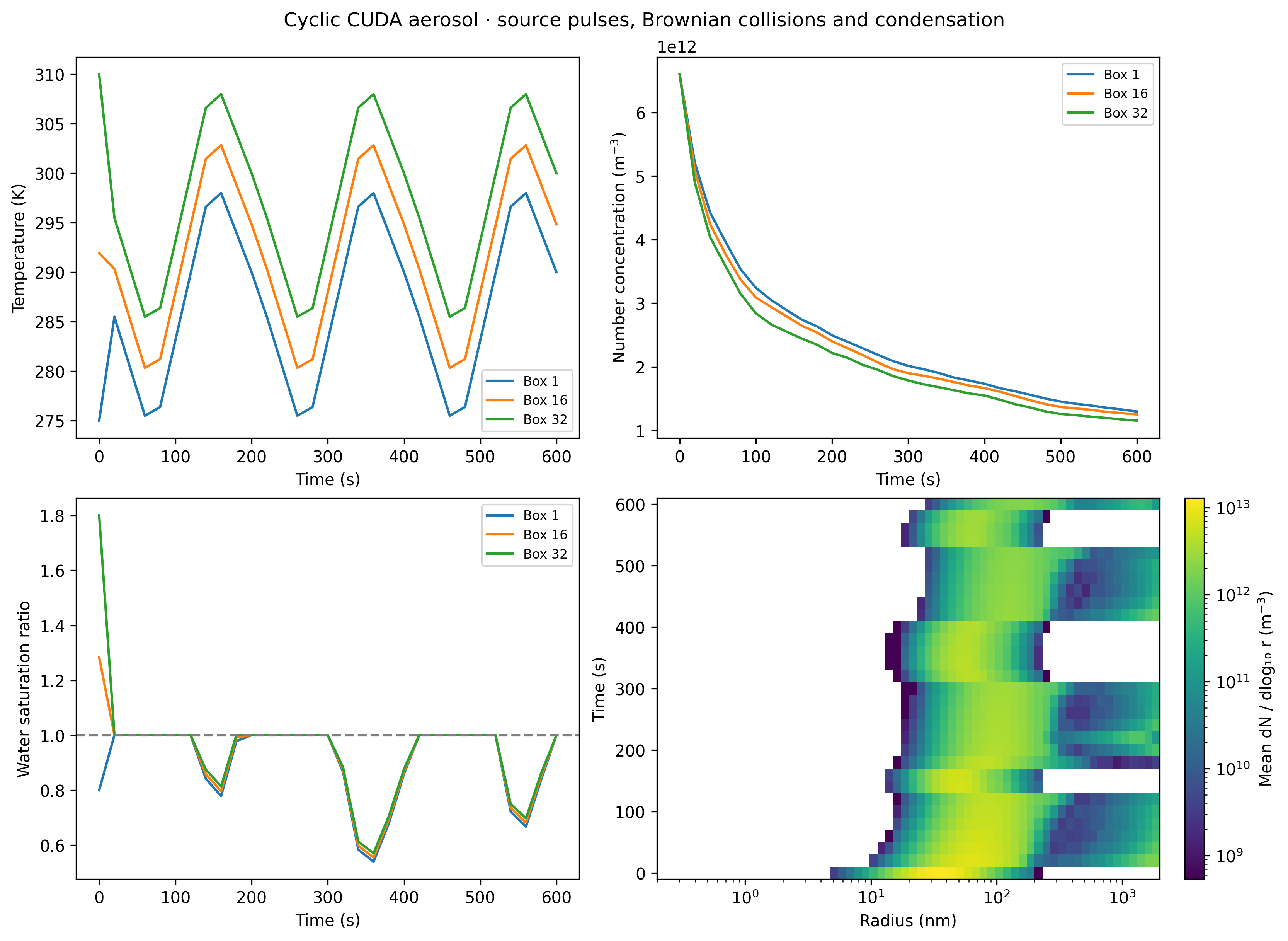
Reproduce the experiment, then qualify its response
Section titled “Reproduce the experiment, then qualify its response”The exact second-half continuation shows that the checkpoint and restored application schedule reproduce this trajectory. The species ledger checks each observed external exchange. Neither check establishes that one-second steps resolve fast condensation following a source or humidity pulse.
The radius-time panel averages box histograms; it can reveal new small-particle cohorts but can hide differences between box temperatures. To investigate pulse spacing, retain per-box distributions, hold total supplied material controlled, and compare size and number after each cycle. Refine both timestep and forcing resolution at identical physical event times before interpreting hysteresis or cohort survival as a physical result.
Explore this topic: Chamber experiments · Condensation and evaporation · Wall loss and dilution