

Which composition rule controls equilibrium pressure?
Python · section 1
"""Activity tutorial for mixing rules and water activity predictions.
This tutorial demonstrates mixing behavior in aerosol solutions, includingideal and non-ideal mixing rules. Topics covered include mass-based andmolar-based activity calculations, and kappa value parameterization forpredicting water activity in non-ideal solutions.
Example:    Run this tutorial to learn about different activity strategies::
        import particula as par        activity_mass = par.particles.ActivityIdealMass()        activities = activity_mass.activity(mass_concentration=[0.2, 0.8])"""# ---# jupyter:#   jupytext:#     text_representation:#       extension: .py#       format_name: percent#       format_version: '1.3'#       jupytext_version: 1.17.3#   kernelspec:#     display_name: .venv#     language: python#     name: python3# ---
'Activity tutorial for mixing rules and water activity predictions.\n\nThis tutorial demonstrates mixing behavior in aerosol solutions, including\nideal and non-ideal mixing rules. Topics covered include mass-based and\nmolar-based activity calculations, and kappa value parameterization for\npredicting water activity in non-ideal solutions.\n\nExample:\n Run this tutorial to learn about different activity strategies::\n\n import particula as par\n activity_mass = par.particles.ActivityIdealMass()\n activities = activity_mass.activity(mass_concentration=[0.2, 0.8])\n'Which composition rule controls equilibrium pressure?
Section titled “Which composition rule controls equilibrium pressure?”A mixture containing 20% water by mass need not have water activity 0.2.
Molecules, mass, and liquid volume weight the same composition differently.
Here we compare three activity approximations for water and a sucrose-like
solute, then see how each changes the flat-interface pressure
The calculation separates two choices: the physical activity rule and the construction interface (direct strategy, builder, or factory). Switching an interface does not itself change the physics. Read the activity functions for a wider composition comparison; curvature is an additional effect omitted here.
Python · section 2
# In Colab uncomment the following command to install particula:# Install from the repository root: `python -m pip install -e ".[extra]"`import matplotlib.pyplot as pltimport numpy as npimport particula as parStart with a mass-fraction approximation
Section titled “Start with a mass-fraction approximation”ActivityIdealMass sets each activity equal to its mass fraction. This is a
mass-based approximation, distinct from the usual mole-fraction Raoult law.
The [water, solute] mass ratio is [0.2, 0.8]; its common absolute scale cancels.
The pressures [100, 10] Pa are deliberately illustrative, not measured water
and sucrose vapor pressures. The returned [20, 8] Pa simply exposes the
multiplication by activity.
Python · section 3
activity_mass = par.particles.ActivityIdealMass()  # no parameters needed
# mixturemass_mixture = np.array([0.2, 0.8])  # water, sucrose
activities = activity_mass.activity(mass_concentration=mass_mixture)print(f"Activities: {activities}")
# partial pressurespure_pressure = np.array([100, 10])  # water, sucrosepartial_pressures = activity_mass.partial_pressure(    pure_vapor_pressure=pure_pressure, mass_concentration=mass_mixture)
print(f"Partial pressures: {partial_pressures}")
Activities: [0.2 0.8]
Partial pressures: [20. 8.]Count molecules instead of mass
Section titled “Count molecules instead of mass”The builder takes molar masses in kg/mol. Water’s smaller molar mass means that 20% of the mixture’s mass represents most of its molecules. Consequently the ideal molar water activity exceeds the mass-based value, while the solute activity is smaller. The pressure change follows from this different model; it is not caused by using a builder instead of direct construction.
Python · section 4
activity_molar = (    par.particles.ActivityIdealMolarBuilder()    .set_molar_mass(        np.array([18.01528, 342.29648]) * 1e-3, "kg/mol"    )  # water, sucrose    .build())
# mixtureactivities = activity_molar.activity(mass_concentration=mass_mixture)print(f"Activities: {activities}")
# partial pressurespure_pressure = np.array([100, 10])  # water, sucrosepartial_pressures = activity_molar.partial_pressure(    pure_vapor_pressure=pure_pressure, mass_concentration=mass_mixture)
print(f"Partial pressures: {partial_pressures}")
Activities: [0.82608954 0.17391046]
Partial pressures: [82.6089542 1.73910458]Give water a hygroscopicity parameter
Section titled “Give water a hygroscopicity parameter”The factory converts the supplied g/mol values and applies the κ water-activity rule using species densities in kg/m³. The solute κ=0.3 and density 1500 kg/m³ are illustrative choices, not a fitted sucrose property set. Water occupies lane zero. Nonwater activities retain the ideal molar rule, so this is not a complete nonideal model for every species.
Python · section 5
parameters_input = {    "density": np.array(        [1000, 1500]    ),  # water, sucrose, kg/m^3 are the base SI default units    "density_units": "kg/m^3",  # this tells the factory what the input units are so it can convert to kg/m^3    "molar_mass": np.array([18.01528, 342.29648]),  # water, sucrose    "molar_mass_units": "g/mol",  # this tells the factory what the input units are so it can convert to kg/mol    "kappa": np.array([0, 0.3]),  # water, sucrose    "water_index": 0,  # water is the first component}
activity_kappa = par.particles.ActivityFactory().get_strategy(    strategy_type="kappa", parameters=parameters_input)
# mixtureactivities = activity_kappa.activity(mass_concentration=mass_mixture)print(f"Activities: {activities}")
# partial pressurespure_pressure = np.array([100, 10])  # water, sucrosepartial_pressures = activity_kappa.partial_pressure(    pure_vapor_pressure=pure_pressure, mass_concentration=mass_mixture)
print(f"Partial pressures: {partial_pressures}")
Activities: [0.55555556 0.17391046]
Partial pressures: [55.55555556 1.73910458]Follow the full composition path
Section titled “Follow the full composition path”Increase water mass fraction while keeping total relative mass equal to one. The solid curves compare water activity under the three assumptions. The dashed κ solute curve coincides with the molar solute curve by construction. Only activities are plotted; the preceding pressure calculations explain how these curves would scale a chosen pure-component vapor pressure.
A separation between curves measures model sensitivity, not which model is accurate. An experimental water-activity relation at the relevant temperature and composition would be needed to decide that.
Python · section 6
mass_water = np.linspace(0.001, 0.9999, 100)mass_sucrose = 1 - mass_watermass_mixture = np.array([mass_water, mass_sucrose]).T
activities_mass = np.zeros_like(mass_mixture)activities_molar = np.zeros_like(mass_mixture)activities_kappa = np.zeros_like(mass_mixture)

for i, mass in enumerate(mass_mixture):    activities_mass[i] = activity_mass.activity(mass_concentration=mass)    activities_molar[i] = activity_molar.activity(mass_concentration=mass)    activities_kappa[i] = activity_kappa.activity(mass_concentration=mass)
fig, ax = plt.subplots(figsize=(8, 6))ax.plot(mass_water, activities_mass[:, 0], label="Mass: Water")ax.plot(    mass_water, activities_mass[:, 1], label="Mass: Sucrose", linestyle="--")ax.plot(mass_water, activities_molar[:, 0], label="Molar: Water")ax.plot(    mass_water,    activities_molar[:, 1],    label="Molar: Sucrose",    linestyle="--",    linewidth=3,    alpha=0.85,)ax.plot(mass_water, activities_kappa[:, 0], label="Kappa: Water")ax.plot(    mass_water, activities_kappa[:, 1], label="Kappa: Sucrose", linestyle="--")ax.set_xlabel("Mass fraction water")ax.set_ylabel("Activity")ax.legend()plt.show()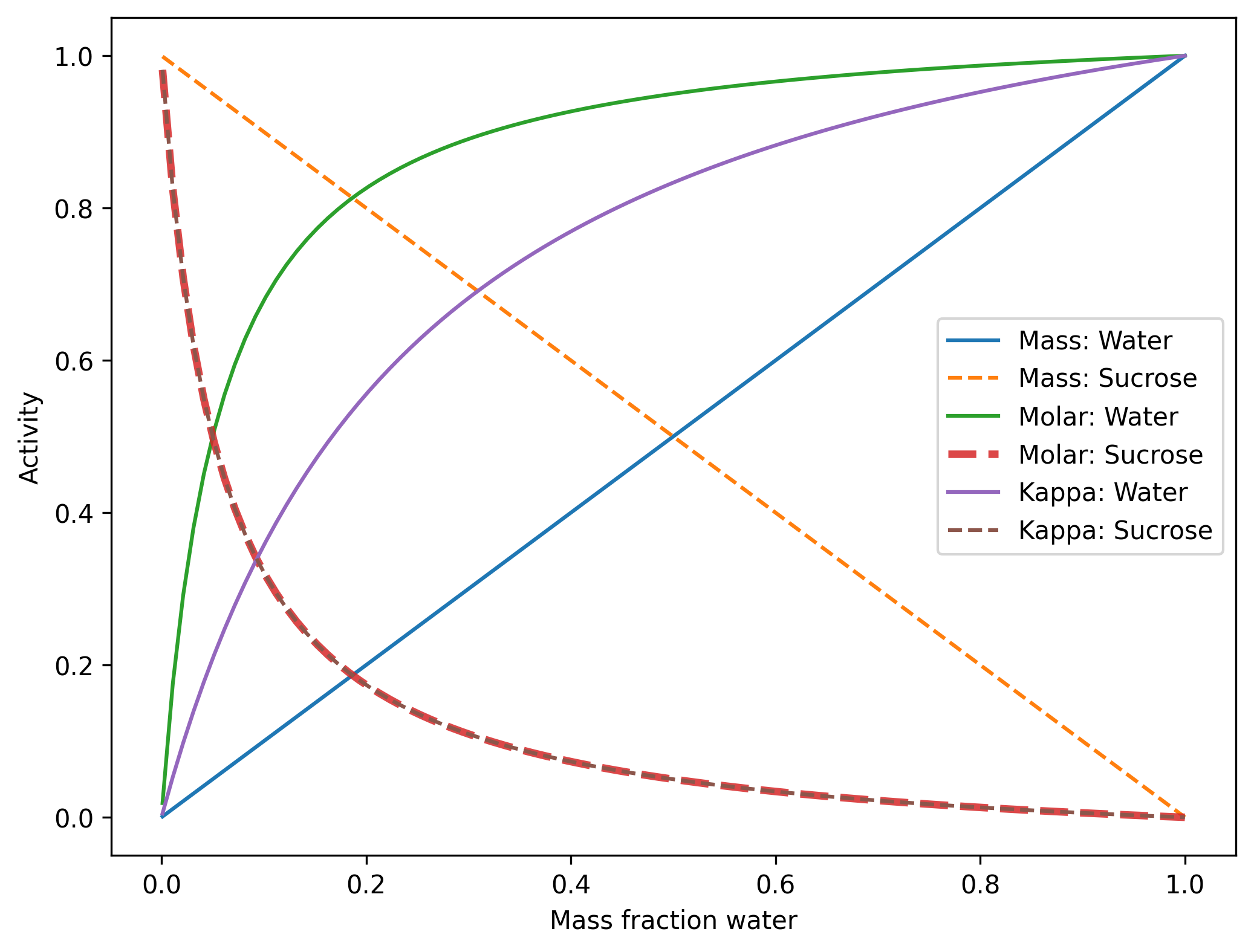
Turn a model choice into a testable question
Section titled “Turn a model choice into a testable question”Composition alone does not determine the pressure reduction until an activity rule is specified. For a light solvent and heavy solute, replacing mass fraction with mole fraction can substantially change that reduction. κ adds a separate water-uptake assumption while leaving the nonwater molar rule intact.
As a useful interface check, construct the same molar model directly, through a builder, and through the factory, then compare activities on this grid. For a scientific extension, fit κ to measured water activity and compare residuals against ideal molar predictions over the measured range. Neither exercise is performed here; fitted behavior outside that range would need new evidence.
Explore this topic: Chemical activity