

Resolve stiff wet–dry droplet relaxation on CUDA
Download Python script · Download script with helper and data files (.zip)
Resolve stiff wet–dry droplet relaxation on CUDA
Section titled “Resolve stiff wet–dry droplet relaxation on CUDA”Can a device-resident stiff method resolve rapid evaporation without the repeated size oscillations shown in the fixed-step comparison? This example repeats that complete 0.4 s humidity-reset experiment with CUDA ROS3. The shared setup represents 10⁸ hygroscopic 100 nm dry seeds per m³, with kappa 0.5 and a finite water-vapor reservoir at 298.15 K. At 0.2 s the external reservoir is reset to 85% saturation. That imposed exchange is accounted for separately from closed-phase condensation.
Download the complete ZIP to retain the shared physical setup and independently coded scalar reference. A real CUDA device is required. The one-representative- particle calculation tests accuracy and error control; it is not a throughput benchmark or qualification of stochastic cloud-chamber coupling.
Python · section 1
import numpy as npimport warp as wpfrom docs.examples.simulations.adaptive_cloud_relaxation import ( C_SAT, DRY_VOLUME, NUMBER, R_DRY, RHO, TIMES, build_case, plot_results, reference,)from particula.execution.gpu_condensation_ode import GPUCondensationODEKeep the humidity event outside adaptive trials
Section titled “Keep the humidity event outside adaptive trials”Each output follows accepted condensation steps. Rejected trials cannot reset the reservoir or emit observations. Trial masses, derivatives and linear solves remain on CUDA; the host controller reads error/status scalars. The requested snapshots explicitly download accepted state. The controller restarts only at the physical humidity event, where the gas inventory is externally replaced.
Python · section 2
def calculate(device, tolerance):    """Run both complete phases with separate closed-phase inventory checks."""    state, strategy = build_case()    dry = state.particles.masses[:, :, 0].copy()    owner = None    rows, work = [], {}    inventory = (        NUMBER * state.particles.masses[0, 0, 1] + state.gas.concentration[0, 0]    )    budget_error = 0.0
    def retain_work(current):        for name, value in vars(current.statistics).items():            work[name] = work.get(name, 0) + value        work["control_readbacks"] = (            work.get("control_readbacks", 0) + current.control_readbacks        )
    for i, time in enumerate(TIMES):        if i:            if owner is None:                owner = GPUCondensationODE(                    state,                    strategy,                    device=device,                    method="ros3",                    time=float(TIMES[i - 1]),                    rtol=tolerance,                    particle_atol=1e-27,                    gas_atol=1e-13,                    first_step=1e-6,                    max_step=0.005,                )            while owner.time < time:                owner.step(float(time))            state = owner.snapshot()        np.testing.assert_array_equal(state.particles.masses[:, :, 0], dry)        total = (            NUMBER * state.particles.masses[0, 0, 1]            + state.gas.concentration[0, 0]        )        budget_error = max(            budget_error, float(abs(total - inventory) / inventory)        )        if time == 0.2:            state.gas.concentration[0, 0] = 0.85 * C_SAT            inventory = (                NUMBER * state.particles.masses[0, 0, 1]                + state.gas.concentration[0, 0]            )            retain_work(owner)            owner = None        rows.append(            [                state.particles.masses[0, 0, 1] / (RHO * DRY_VOLUME),                state.gas.concentration[0, 0],            ]        )    retain_work(owner)    assert budget_error < 2e-12    return np.asarray(rows), work, budget_error

def run_cuda():    """Cross-check references and require refinement on the actual CUDA device."""    wp.init()    if not wp.is_cuda_available():        raise RuntimeError("This wet–dry comparison requires real CUDA")    device = wp.get_device("cuda:0")    reference_water, reference_gas = reference("Radau")    check_water, check_gas = reference("BDF")    np.testing.assert_allclose(        check_water, reference_water, rtol=2e-8, atol=1e-9    )    np.testing.assert_allclose(check_gas, reference_gas, rtol=2e-10, atol=1e-12)    reference_radius = R_DRY * np.cbrt(1 + reference_water)    results = {}    for tolerance in (1e-5, 1e-7):        values, work, budget = calculate(device.alias, tolerance)        radius = R_DRY * np.cbrt(1 + values[:, 0])        error = float(np.max(abs(radius / reference_radius - 1)))        assert error < 2e-5        results[f"CUDA ROS3 {tolerance:.0e}"] = {            "radius_nm": (radius * 1e9).tolist(),            "gas_kg_m3": values[:, 1].tolist(),            "radius_error": error,            "budget_error": budget,            "work": work,        }    coarse, tight = results.values()    assert tight["radius_error"] < coarse["radius_error"] / 10    print("CUDA device:", device.name)    return {        "time_s": TIMES.tolist(),        "reference_radius_nm": (reference_radius * 1e9).tolist(),        "results": results,        "device": {"alias": device.alias, "name": device.name},        "configuration": {            "dry_radius_m": R_DRY,            "number_m3": NUMBER,            "kappa": 0.5,        },    }
Judge accuracy and budgets separately
Section titled “Judge accuracy and budgets separately”The plotted error compares every saved radius with the independent reference, including the rapid response immediately after the humidity reset. Tightening the tolerance must reduce the maximum error by at least a factor of ten, and both profiles must satisfy a 2×10⁻⁵ relative radius target. The separate mass check does not substitute for that trajectory comparison. In the retained RTX 5060 run, tightening rtol from 10⁻⁵ to 10⁻⁷ reduces the maximum radius error from 4.07×10⁻⁶ to 3.24×10⁻⁸. Accepted steps increase from 330 to 1,251, with zero and two rejected trials. Closed-phase mass residuals stay below 4×10⁻¹⁵; the humidity reset is an external exchange.
To extend this experiment, vary dry size and composition while retaining an independent reference, or resolve a heterogeneous population and record the fastest box’s effect on the shared controller. Those extensions are not run here. Coupling source or collision events also needs a fixed outer schedule, explicit transfer accounting and separate stochastic validation.
Python · section 3
if __name__ == "__main__": report = run_cuda() plot_results(report)Explicit cuda invocation
report = run_cuda()figure = plot_results(report)CUDA ROS3 1e-05 max radius error: 4.06940316399762e-06 mass residual: 7.090447494683783e-16 work: {'accepted': 330, 'rejected': 0, 'domain_rejected': 0, 'rate_calls': 1980, 'jacobian_calls': 330, 'time_derivative_calls': 0, 'factorizations': 0, 'linear_solves': 990, 'control_readbacks': 6270}
CUDA ROS3 1e-07 max radius error: 3.2434184449314785e-08 mass residual: 3.722484934828969e-15 work: {'accepted': 1251, 'rejected': 2, 'domain_rejected': 0, 'rate_calls': 7518, 'jacobian_calls': 1253, 'time_derivative_calls': 0, 'factorizations': 0, 'linear_solves': 3759, 'control_readbacks': 23807}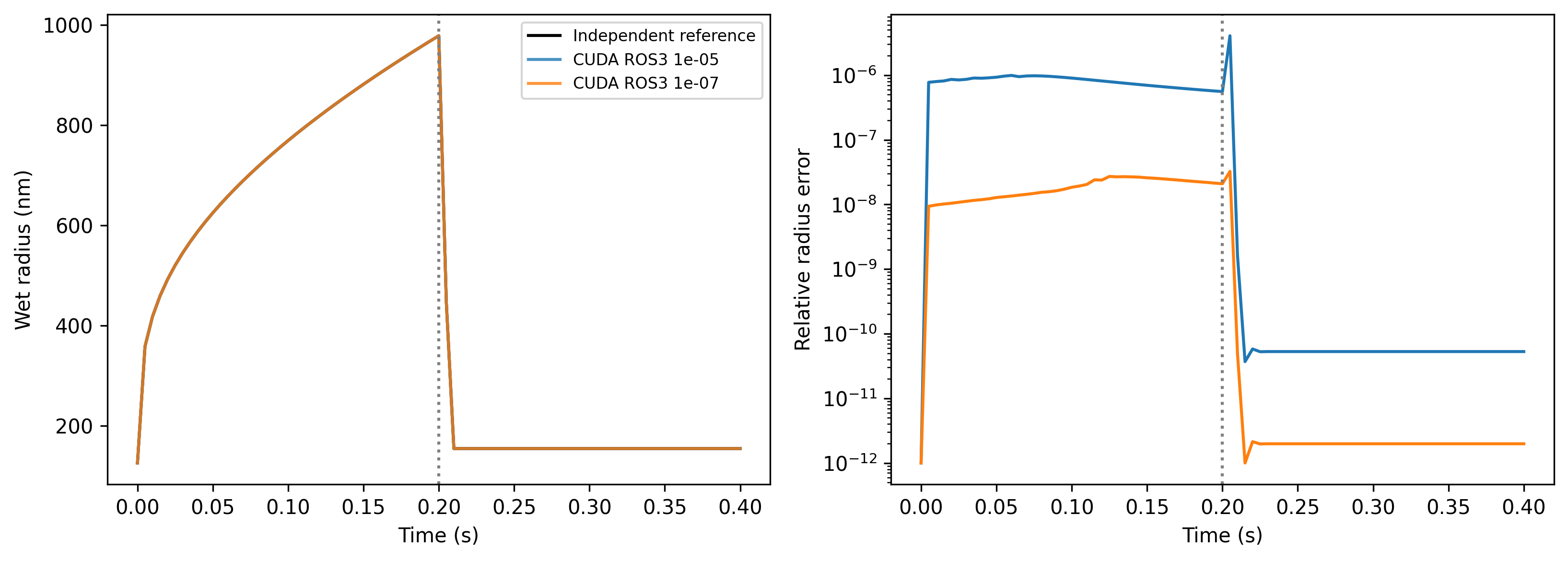
Explore this topic: Adaptive growth and relaxation · GPU workflows · Chamber experiments