

Extend a process on CPU and CUDA
Download Python script · Download script with helper and data files (.zip)
Extend a process on CPU and CUDA
Section titled “Extend a process on CPU and CUDA”How can a new process change execution backend without changing its scientific meaning? An exactly integrable forcing law provides a reference independent of either implementation. You will compare numerical trajectories, state ownership, and restart behavior before attempting a more complex physical extension. Read the prepared workflow first.
This Particula 0.3 development example implements the same prescribed warming law in NumPy and Warp: dT/dt = a t, with a in K s⁻² and absolute time t in s. A registered box field records cumulative warming in K. This is an imposed boundary condition, not an energy-conserving atmospheric heating model. Native dilution is composed after the custom operation.
We compare pure CPU, resident CUDA, captured resident CUDA and explicit
CPUTransfer execution in two boxes. We check the analytical trajectory,
detached snapshots and exact checkpoint continuation. CUDA is required;
there is no CPU fallback and this small example makes no speedup claim.
Download the ZIP to include the Warp kernel helper. Install Particula,
NumPy, Matplotlib and Warp, then run python example.py from the extracted
directory. All extension code uses public interfaces.
Python · section 1
"""Equivalent public NumPy/Warp extensions with explicit transfer and restart."""
import matplotlib.pyplot as pltimport numpy as npimport warp as wpfrom particula import (    Aerosol,    BoxProcess,    CPUTransfer,    FieldSpec,    GPUProcessPlan,    PreparedOperation,    ProcessCapabilities,    ProcessRegistry,)from particula.dynamics import Dilution, DilutionStrategyfrom particula.gas import EnvironmentData, GasDatafrom particula.particles import ParticleDatafrom scripts.gpu_studies.extension_kernels import prescribed_warming

class PrescribedWarming(BoxProcess):    """Integrate a time-dependent external temperature forcing."""
    def __init__(self, rate=0.02):        """Declare configuration and permitted native/registered destinations."""        if not np.isfinite(rate) or rate < 0:            raise ValueError("rate must be finite and nonnegative")        self.rate = float(rate)        super().__init__(            name="warming",            extension_id="example.prescribed_warming",            reads=("environment.temperature", "demo.warming"),            writes=("environment.temperature", "demo.warming"),            parameters=(self.rate,),        )
    def validate(self, aerosol):        """Require a per-box registered warming field with Kelvin units."""        spec = aerosol.fields.specs.get("demo.warming")        if spec is None or spec.axes != ("box",) or spec.units != "K":            raise ValueError("demo.warming must be a box field in K")
    def advance(self, aerosol, *, time, time_step, context):        """Advance ordinary NumPy arrays in place over the exact interval."""        increment = self.rate * (time * time_step + 0.5 * time_step**2)        aerosol.environment.temperature[:] += increment        aerosol.fields["demo.warming"][:] += increment

class WarmingAdapter:    """Explicit resident implementation; registration matches the exact class."""
    def plan(self, process, aerosol):        """Validate detached host state and freeze immutable configuration."""        process.validate(aerosol)        return GPUProcessPlan(            name=process.name,            extension_id=process.extension_id,            version=process.version,            reads=process.reads,            writes=process.writes,            parameters=(("rate", process.rate),),            capabilities=ProcessCapabilities(                resident=True, capture=True, checkpoint=True            ),        )
    def prepare(self, plan, context):        """Retain fixed buffers once; later calls only enqueue the kernel."""        temperature = context.arrays["environment.temperature"]        args = (            temperature,            context.arrays["demo.warming"],            context.clock,            context.failure,            wp.float64(plan.values["rate"]),            wp.float64(context.time_step),        )
        def enqueue():            wp.launch(                prescribed_warming,                dim=len(context.logical_box_ids),                inputs=args,                device=context.device,            )
        return PreparedOperation(plan.name, enqueue, args, plan.capabilities)
Choose execution explicitly
Section titled “Choose execution explicitly”ProcessRegistry connects the exact CPU process class to its GPU adapter.
A resident kernel checks the shared failure flag, writes only declared
buffers, and reads interval time from the device clock. It must not allocate,
download or synchronize during a timestep. Python launch closures are trusted
implementations, not a security sandbox.
CPUTransfer(process) opts into a host round trip instead. Particula downloads
state, runs the ordinary transactional CPU callback and uploads permitted
writes into existing device buffers. This accepts arbitrary Python libraries
but cannot be captured. It can still checkpoint and resume. A snapshot is
detached analysis data; a checkpoint preserves exact continuation state.
Python · section 2
def build_aerosol():    """Construct two independent boxes and an owned warming field."""    state = Aerosol(        particles=ParticleData(            masses=np.full((2, 4, 1), 1e-18),            concentration=np.ones((2, 4)),            charge=np.zeros((2, 4)),            density=np.array([1000.0]),            volume=np.array([1e-6, 2e-6]),            distribution_type="particle_resolved",        ),        gas=GasData(            name=["inert"],            molar_mass=np.array([0.029]),            concentration=np.full((2, 1), 1e-6),            partitioning=np.array([False]),        ),        environment=EnvironmentData(            temperature=np.array([280.0, 300.0]),            pressure=np.full(2, 101325.0),            saturation_ratio=np.zeros((2, 1)),        ),    )    state.fields.add(FieldSpec("demo.warming", ("box",), "K", minimum=0))    return state

def compare_checkpoint(left, right):    """Compare canonical physical/field bytes and absolute time continuation."""    assert left.resident.payloads == right.resident.payloads    assert left.field_payloads == right.field_payloads    assert left.extension_state == right.extension_state    assert left.host_rng == right.host_rng    assert left.clock == right.clock    assert left.resident.completed_steps == right.resident.completed_steps    assert left.resident.simulated_time == right.resident.simulated_time

def gpu_trajectory(mode, times):    """Run one explicit GPU mode and verify restart from its midpoint."""    initial = build_aerosol()    registry = ProcessRegistry()    registry.register(PrescribedWarming, WarmingAdapter())    warming = PrescribedWarming()    custom = CPUTransfer(warming) if mode == "transfer" else warming    processes = custom | Dilution(DilutionStrategy(0.01))    history = [initial.environment.temperature.copy()]    with processes.prepare(        initial,        device="cuda:0",        time_step=0.5,        time=float(times[0]),        process_registry=registry,    ) as sim:        before = sim.checkpoint()        if mode == "captured":            sim.capture()            compare_checkpoint(sim.checkpoint(), before)        elif mode == "transfer":            try:                sim.capture()            except ValueError:                pass            else:                raise AssertionError("CPUTransfer unexpectedly captured")            compare_checkpoint(sim.checkpoint(), before)        for step in range(1, len(times)):            sim.step()            snapshot = sim.snapshot()            history.append(snapshot.environment.temperature.copy())            assert sim.current_time == times[step]            if step == 20:                saved = sim.checkpoint()                # Changing detached analysis data cannot alter device state.                snapshot.environment.temperature[:] = -1                snapshot.fields["demo.warming"][:] = -1                compare_checkpoint(sim.checkpoint(), saved)        final = sim.checkpoint()        final_state = sim.snapshot()    with processes.resume(saved, process_registry=registry) as resumed:        if mode == "captured":            resumed.capture()        resumed.run(20)        compare_checkpoint(resumed.checkpoint(), final)    np.testing.assert_allclose(        final_state.fields["demo.warming"],        0.01 * (times[-1] ** 2 - times[0] ** 2),        rtol=1e-14,    )    np.testing.assert_allclose(        final_state.gas.concentration,        initial.gas.concentration * np.exp(-0.01 * 20),        rtol=1e-13,    )    np.testing.assert_array_equal(initial.fields["demo.warming"], 0)    return np.asarray(history)

def simulate():    """Compare all four execution paths with an independent exact solution."""    if not wp.is_cuda_available():        raise RuntimeError("This example requires real CUDA")    times = np.arange(41) * 0.5 + 5.0    initial = build_aerosol()    cpu = build_aerosol()    processes = PrescribedWarming() | Dilution(DilutionStrategy(0.01))    history = [cpu.environment.temperature.copy()]    for time in times[:-1]:        processes.execute(cpu, 0.5, time=float(time))        history.append(cpu.environment.temperature.copy())    trajectories = {"cpu": np.asarray(history)}    for mode in ("resident", "captured", "transfer"):        trajectories[mode] = gpu_trajectory(mode, times)    expected = initial.environment.temperature + 0.01 * (        times[:, None] ** 2 - times[0] ** 2    )    for values in trajectories.values():        np.testing.assert_allclose(values, expected, rtol=1e-14, atol=1e-12)    np.testing.assert_array_equal(        trajectories["captured"], trajectories["resident"]    )    return dict(        time=times.tolist(),        reference=expected.tolist(),        trajectories={            key: values.tolist() for key, values in trajectories.items()        },        device=wp.get_device("cuda:0").name,    )
Python · section 3
def plot_results(report):    """Compare trajectories and numerical residuals from compact saved data."""    reference = np.asarray(report["reference"])    fig, axes = plt.subplots(1, 2, figsize=(11, 4.2), constrained_layout=True)    colors = {        "cpu": "black",        "resident": "tab:blue",        "captured": "tab:green",        "transfer": "tab:orange",    }    for mode, history in report["trajectories"].items():        values = np.asarray(history)        axes[1].plot(            report["time"],            np.max(np.abs(values - reference), axis=1),            label=mode,            color=colors[mode],        )    resident = np.asarray(report["trajectories"]["resident"])    for box in range(2):        axes[0].plot(report["time"], resident[:, box], label=f"Box {box + 1}")        axes[0].plot(report["time"][::4], reference[::4, box], "k.")    axes[0].set(        ylabel="Temperature (K)", title="Resident CUDA · dots: exact solution"    )    axes[1].set(        ylabel="Maximum absolute error (K)", title="All four execution paths"    )    for ax in axes:        ax.set_xlabel("Absolute simulation time (s)")        ax.legend()        ax.grid(alpha=0.2)    plt.show()

def run_example():    """Execute the complete CUDA comparison and render its verified outputs."""    report = simulate()    print("CUDA device:", report["device"])    print("NumPy/Warp parity, detached snapshots, capture and restart passed.")    plot_results(report)    return report

if __name__ == "__main__":    run_example()
Explicit cuda invocation
report = run_example()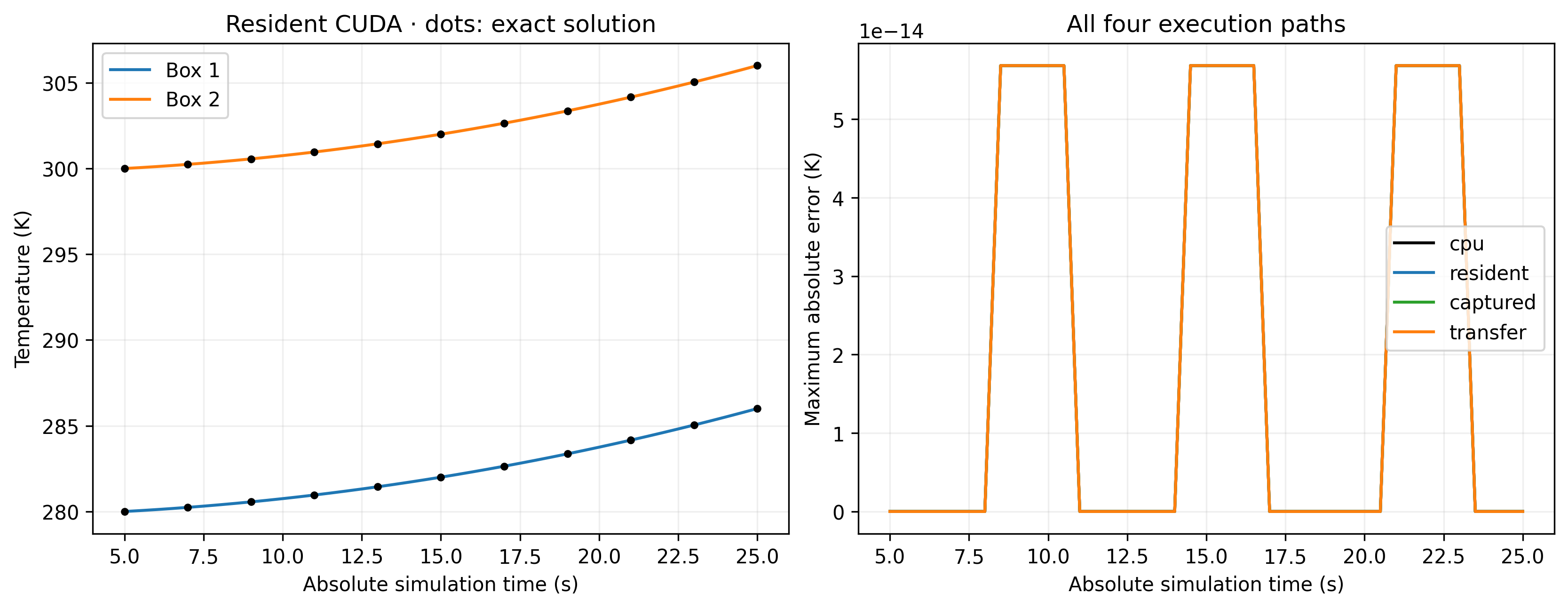
Use a known answer before a complicated process
Section titled “Use a known answer before a complicated process”The temperature panel shows the same warming increment in two boxes with different initial temperatures; reference dots come from the analytic integral. The residual panel compares all four execution paths with that reference over absolute time 5–25 s. The registered warming field accumulates 6 K, independently of the dilution of particles and gas. Agreement checks this imposed law and its clock handling, not an atmospheric heat budget.
For a custom chemistry or energy process, first choose a limiting case with an independent solution and declared units, reads, writes, and conserved quantities. Compare CPU, resident, and restart paths there before adding nonlinear coupling. Use explicit host transfer when a needed solver has no resident implementation, and measure the full transfer cost before deciding whether to port it.
Explore this topic: Custom processes and fields