

Five direct CUDA process boundaries
Five direct CUDA process boundaries
Section titled “Five direct CUDA process boundaries”Can a final aerosol snapshot tell you which process caused a change? This example exposes the ordered device boundaries and the limits of a before/after comparison. Use the direct condensation example first if transfers, species maps, or caller-owned storage are unfamiliar.
Upload particles, gas and environment once, retain explicit sidecars, and
restore the complete CPU result after the ordered calls.
Run this script with --cuda to reproduce the published figures.
The unflagged command retains its portable Warp CPU regression.
Python · section 1
"""Run five direct Warp steps with explicit container conversions and restore.
The enabled path converts CPU particle, gas, and environment containers once,then calls condensation, coagulation, dilution, wall loss, and nucleation inthat order. It performs one explicit final synchronization and restores eachCPU container once after all five calls succeed. Device selection, conversion,sidecars, RNG state, synchronization, and restoration remain caller-owned.
Warp imports are lazy. A forced or naturally unavailable Warp runtime returnsdeterministic no-kernel metadata without allocating, converting, synchronizing,restoring, or selecting a CPU substitute. Direct-boundary errors propagate;this example is not a scheduler, backend selector, resident loop, high-levelRunnable, or CPU fallback."""
from __future__ import annotations
import importlibimport osfrom dataclasses import dataclassfrom types import SimpleNamespacefrom typing import Any
import numpy as npfrom particula.gas import EnvironmentData, GasDatafrom particula.particles import ParticleData
_FORCE_NO_WARP_ENV = "PARTICULA_EXAMPLE_FORCE_NO_WARP"

@dataclassclass ExampleRun:    """Store deterministic output and optional CPU and caller-owned GPU state.
    Every optional field is ``None`` when Warp is unavailable or disabled.
    Attributes:        output: Deterministic, address-free status lines.        particle_data: Particle data restored after the final synchronization.        gas_data: Gas data restored with its original ordered names.        environment_data: Environment data restored after the final            synchronization.        mass_transfer: Caller-owned condensation transfer sidecar.        collision_pairs: Caller-owned coagulation collision-pair sidecar.        n_collisions: Caller-owned coagulation count sidecar.        coagulation_rng: Persistent caller-owned coagulation RNG sidecar.        wall_rng: Persistent caller-owned wall-loss RNG sidecar.        nucleation_diagnostics: Caller-owned nucleation diagnostic sidecars.        dilution_particles: Resident particle container returned by dilution.        dilution_gas: Resident gas container returned by dilution.        wall_particles: Resident particle container returned by wall loss.        nucleation_particles: Resident particle container returned by            nucleation.        nucleation_gas: Resident gas container returned by nucleation.    """
    output: list[str]    particle_data: ParticleData | None = None    gas_data: GasData | None = None    environment_data: EnvironmentData | None = None    mass_transfer: Any | None = None    collision_pairs: Any | None = None    n_collisions: Any | None = None    coagulation_rng: Any | None = None    wall_rng: Any | None = None    nucleation_diagnostics: Any | None = None    dilution_particles: Any | None = None    dilution_gas: Any | None = None    wall_particles: Any | None = None    nucleation_particles: Any | None = None    nucleation_gas: Any | None = None

def _build_cpu_state() -> tuple[    ParticleData, GasData, EnvironmentData, list[str]]:    """Create a deterministic one-box CPU fixture for the direct process path.
    The particle storage has two active and two exactly-free fixed slots. Gas    names are copied before conversion because Warp gas data does not own them.    Both active slots carry two resolved counts in 1e-6 m³. Native coagulation    requires equal positive counts: the former unequal 2/5 fixture was not    supported by that contract. This is an illustrative sequence, not a    calibrated population. Condensation couples gas using counts/volume.
    Returns:        CPU particle, gas, and environment containers plus copied gas names.    """    particle_data = ParticleData(        masses=np.array(            [[[1.0e-18, 2.0e-18], [0.0, 0.0], [3.0e-18, 0.0], [0.0, 0.0]]],            dtype=np.float64,        ),        concentration=np.array([[2.0, 0.0, 2.0, 0.0]], dtype=np.float64),        charge=np.array([[1.0, 0.0, -2.0, 0.0]], dtype=np.float64),        density=np.array([1000.0, 1500.0], dtype=np.float64),        volume=np.array([1.0e-6], dtype=np.float64),        distribution_type="particle_resolved",    )    gas_data = GasData(        name=["water", "organic"],        molar_mass=np.array([0.018, 0.098], dtype=np.float64),        concentration=np.array([[1.0e-9, 2.0e-9]], dtype=np.float64),        partitioning=np.array([True, True], dtype=np.bool_),    )    environment_data = EnvironmentData(        temperature=np.array([298.15], dtype=np.float64),        pressure=np.array([101325.0], dtype=np.float64),        saturation_ratio=np.ones((1, 2), dtype=np.float64),    )    return particle_data, gas_data, environment_data, list(gas_data.name)

def _warp_enabled() -> bool:    """Check whether Warp can be probed without loading GPU helper modules.
    The force-disable environment variable short-circuits before the probe.    An unavailable Warp import returns ``False`` without conversion, allocation,    synchronization, restoration, or a CPU fallback.
    Returns:        ``True`` when the Warp module imports; otherwise, ``False``.    """    if os.getenv(_FORCE_NO_WARP_ENV) == "1":        return False    try:        importlib.import_module("warp")    except ImportError:        return False    return True

def _load_enabled_runtime() -> SimpleNamespace | None:    """Lazily load enabled-only direct boundaries and their concrete records.
    This loader is reached only after the standalone Warp probe succeeds. It    binds the five public direct calls and keeps concrete configuration and    sidecar records at their owning modules.
    Returns:        The enabled Warp runtime namespace, or ``None`` when the GPU package        reports that Warp is unavailable.    """    wp = importlib.import_module("warp")    gpu = importlib.import_module("particula.gpu")    if not gpu.WARP_AVAILABLE:        return None    kernels = importlib.import_module("particula.gpu.kernels")    condensation = importlib.import_module("particula.gpu.kernels.condensation")    thermodynamics = importlib.import_module(        "particula.gpu.kernels.thermodynamics"    )    coagulation = importlib.import_module("particula.gpu.kernels.coagulation")    wall_loss = importlib.import_module("particula.gpu.kernels.wall_loss")    exhaustion = importlib.import_module("particula.gpu.kernels.exhaustion")    nucleation = importlib.import_module("particula.gpu.kernels.nucleation")    return SimpleNamespace(        wp=wp,        gpu=gpu,        to_warp_particle_data=gpu.to_warp_particle_data,        to_warp_gas_data=gpu.to_warp_gas_data,        to_warp_environment_data=gpu.to_warp_environment_data,        from_warp_particle_data=gpu.from_warp_particle_data,        from_warp_gas_data=gpu.from_warp_gas_data,        from_warp_environment_data=gpu.from_warp_environment_data,        condensation_step_gpu=kernels.condensation_step_gpu,        coagulation_step_gpu=kernels.coagulation_step_gpu,        dilution_step_gpu=kernels.dilution_step_gpu,        wall_loss_step_gpu=kernels.wall_loss_step_gpu,        nucleation_step_gpu=kernels.nucleation_step_gpu,        CondensationScratchBuffers=condensation.CondensationScratchBuffers,        ThermodynamicsConfig=thermodynamics.ThermodynamicsConfig,        CoagulationMechanismConfig=coagulation.CoagulationMechanismConfig,        NeutralWallLossConfig=wall_loss.NeutralWallLossConfig,        ResamplingBuffers=exhaustion.ResamplingBuffers,        NucleationConfig=nucleation.NucleationConfig,        NucleationScratchBuffers=nucleation.NucleationScratchBuffers,        NucleationFinalizedDemandBuffers=(            nucleation.NucleationFinalizedDemandBuffers        ),        NucleationDiagnosticBuffers=nucleation.NucleationDiagnosticBuffers,        NucleationExhaustionBuffers=nucleation.NucleationExhaustionBuffers,        NucleationExhaustionControls=nucleation.NucleationExhaustionControls,    )

def _prepare_species_bindings(    particles: Any, gas: Any, names: list[str]) -> tuple[Any, Any]:    """Upload explicit process maps for the current transferred carriers.
    Both processes map water and organic gas lanes to their particle material    lanes. Maps are configuration, not a second transfer of physical state.    They remain bound to these exact carriers and arrays.    """    from particula.dynamics.condensation.species_mapping import (        CondensationSpeciesMap,    )    from particula.dynamics.nucleation.species_mapping import (        NucleationSpeciesMap,    )    from particula.gpu.nucleation_species_mapping import (        prepare_nucleation_species_map,    )    from particula.gpu.species_mapping import prepare_condensation_species_map
    return (        prepare_condensation_species_map(            particles,            gas,            gas_names=names,            species_map=CondensationSpeciesMap(tuple(names), ((0, 0), (1, 1))),        ),        prepare_nucleation_species_map(            particles,            gas,            gas_names=names,            species_map=NucleationSpeciesMap(tuple(names), ((0, 0), (1, 1))),        ),    )

def _allocate_sidecars(    runtime: SimpleNamespace,    device: str,    dimensions: tuple[int, int, int],    molar_mass: np.ndarray,) -> SimpleNamespace:    """Allocate all caller-owned direct-process sidecars exactly once.
    Args:        runtime: Lazily loaded Warp, helper, and concrete-record namespace.        device: Active Warp device for every sidecar.        dimensions: Fixed ``(B, N, S)`` process dimensions.        molar_mass: Ordered CPU molar masses used by thermodynamics metadata.
    Returns:        Namespace holding every sidecar and immutable direct-step metadata.        Every Warp array uses ``device`` and the fixed process dimensions.    """    boxes, particles, species = dimensions    wp = runtime.wp
    def f64(shape: tuple[int, ...]) -> Any:        return wp.zeros(shape, dtype=wp.float64, device=device)
    def i32(shape: tuple[int, ...]) -> Any:        return wp.zeros(shape, dtype=wp.int32, device=device)
    def u32(shape: tuple[int, ...]) -> Any:        return wp.zeros(shape, dtype=wp.uint32, device=device)
    transfer_shape = (boxes, particles, species)    resampling = runtime.ResamplingBuffers(        retained_counts=i32((boxes,)),        released_counts=i32((boxes,)),        retained_indices=i32((boxes, particles)),        released_indices=i32((boxes, particles)),        sorted_indices=i32((boxes, particles)),        replacement_masses=f64(transfer_shape),        replacement_concentration=f64((boxes, particles)),        replacement_charge=f64((boxes, particles)),        source_radii=f64((boxes, particles)),        radius_cubed_relative_error=f64((boxes,)),        mean_radius_relative_error=f64((boxes,)),        surface_relative_error=f64((boxes,)),        diversity_absolute_error=f64((boxes,)),        planning_status=i32((boxes,)),    )    return SimpleNamespace(        condensation_scratch=runtime.CondensationScratchBuffers(            work_mass_transfer=f64(transfer_shape),            total_mass_transfer=f64(transfer_shape),            dynamic_viscosity=f64((boxes,)),            mean_free_path=f64((boxes,)),            positive_mass_transfer_demand=f64((boxes, species)),            negative_mass_transfer_release=f64((boxes, species)),            positive_mass_transfer_scale=f64((boxes, species)),        ),        thermodynamics=runtime.ThermodynamicsConfig(            modes=i32((species,)),            parameters=wp.array(                np.column_stack(                    (np.full(species, 1.0e-12), np.zeros((species, 3)))                ),                dtype=wp.float64,                device=device,            ),            molar_mass_reference=wp.array(                molar_mass, dtype=wp.float64, device=device            ),        ),        collision_pairs=wp.full(            (boxes, particles, 2), -1, dtype=wp.int32, device=device        ),        n_collisions=i32((boxes,)),        coagulation_rng=u32((boxes,)),        wall_rng=u32((boxes,)),        resampling=resampling,        nucleation_scratch=runtime.NucleationScratchBuffers(            precursor_number_concentration=f64((boxes,)),            potential_rate=f64((boxes,)),            potential_demand=f64((boxes,)),        ),        finalized_demand=runtime.NucleationFinalizedDemandBuffers(            accepted_counts=i32((boxes,)),            accepted_demand=f64((boxes,)),            precursor_mass_change=f64((boxes, species)),        ),        diagnostics=runtime.NucleationDiagnosticBuffers(            gate_codes=i32((boxes,)),            selected_slot_indices=wp.full(                (boxes, particles), -1, dtype=wp.int32, device=device            ),            free_slot_indices=wp.full(                (boxes, particles), -1, dtype=wp.int32, device=device            ),            active_slot_counts=i32((boxes,)),            free_slot_counts=i32((boxes,)),        ),        exhaustion=runtime.NucleationExhaustionBuffers(            resampling_buffers=resampling,            demand_workspace=f64((boxes,)),            final_demand=f64((boxes,)),            requested_scale=wp.ones((boxes,), dtype=wp.float64, device=device),            minimum_scale=wp.ones((boxes,), dtype=wp.float64, device=device),            minimum_volume=wp.full(                (boxes,), 1.0e-12, dtype=wp.float64, device=device            ),            resolved_scale=f64((boxes,)),            resampling_releasable_counts=i32((boxes,)),            required_release_counts=i32((boxes,)),            scaling_required=i32((boxes,)),            final_counts=i32((boxes,)),            final_selected_slot_indices=i32((boxes, particles)),        ),    )

def _output_prefix(    particle_data: ParticleData,    gas_data: GasData,    environment_data: EnvironmentData,) -> list[str]:    """Build stable, address-free contract output for the CPU fixture.
    Args:        particle_data: CPU particle fixture used to report capacity shape.        gas_data: CPU gas fixture used to report concentration shape.        environment_data: CPU environment fixture used to report box shape.
    Returns:        User-facing lines describing ordering, ownership, and exclusions.    """    return [        "Canonical path: docs/examples/gpu/direct/gpu_complete_process_sequence.py",        (            "CPU fixture: "            f"particles={particle_data.masses.shape}, "            f"gas={gas_data.concentration.shape}, "            f"environment={environment_data.temperature.shape}"        ),        (            "Process order: condensation -> coagulation -> dilution -> "            "wall loss -> nucleation."        ),        (            "Ownership: conversions, sidecars, RNG state, synchronization, "            "and the final restore stay caller-owned."        ),        ("Runtime: Warp CPU is the default when installed; CUDA is optional."),        (            "Exclusions: no scheduler, backend selection, resident loop, "            "Runnable, or CPU fallback."        ),    ]

def _disabled_output() -> list[str]:    """Build stable output for a path that constructs no CPU fixture.
    Returns:        User-facing lines describing the lazy no-Warp contract.    """    return [        "Canonical path: docs/examples/gpu/direct/gpu_complete_process_sequence.py",        "CPU fixture: not constructed because Warp is unavailable or disabled.",        (            "Exclusions: no scheduler, backend selection, resident loop, "            "Runnable, or CPU fallback."        ),        "Warp is unavailable or disabled; no kernel ran.",    ]

def _sidecar_sum(values: Any) -> float:    """Return a synchronized sidecar's deterministic scalar sum."""    return float(np.sum(values.numpy(), dtype=np.float64))

def run_example(device: str = "cpu") -> ExampleRun:    """Run five direct boundaries with one conversion per CPU container.
    The enabled path makes exactly five direct calls in this order:    condensation, coagulation, dilution, wall loss, and nucleation. It retains    the same resident containers and caller-owned sidecars across those calls,    then performs one explicit final synchronization and restores only once.    Direct-boundary validation may synchronize internally. A zero nucleation    time demonstrates its direct boundary only; it is not a calibrated schedule.    Errors deliberately propagate without fallback or an intermediate restore.
    Args:        device: Warp device for the explicit direct path; defaults to Warp CPU.
    Returns:        Deterministic no-kernel metadata when Warp is disabled or unavailable;        otherwise, final restored CPU data and caller-owned sidecars.
    Raises:        ImportError: If enabled-only runtime loading cannot import a dependency.        ValueError: If a direct boundary rejects the supplied process state.    """    if not _warp_enabled():        return ExampleRun(output=_disabled_output())    runtime = _load_enabled_runtime()    if runtime is None:        return ExampleRun(output=_disabled_output())    particle_data, gas_data, environment_data, gas_names = _build_cpu_state()    output = _output_prefix(particle_data, gas_data, environment_data)
    gpu_particles = runtime.gpu.to_warp_particle_data(        particle_data, device=device    )    gpu_gas = runtime.gpu.to_warp_gas_data(gas_data, device=device)    gpu_environment = runtime.gpu.to_warp_environment_data(        environment_data, device=device    )    condensation_binding, nucleation_binding = _prepare_species_bindings(        gpu_particles, gpu_gas, gas_names    )    sidecars = _allocate_sidecars(        runtime, device, particle_data.masses.shape, gas_data.molar_mass    )    wall_config = runtime.NeutralWallLossConfig(        geometry="spherical",        wall_eddy_diffusivity=0.01,        chamber_radius=0.5,        distribution_type="particle_resolved",        mode="charged",        wall_potential=0.05,        wall_electric_field=0.0,    )    nucleation_config = runtime.NucleationConfig(        rate_law="activation",        coefficient=1.0e-12,        survival_factor=1.0,        precursor_index=0,        molecule_counts=(1, 0),        formation_diameter=1.0e-9,        precursor_number_concentration_lower=0.0,        precursor_number_concentration_upper=1.0e30,        temperature_lower=200.0,        temperature_upper=400.0,    )    mechanism_config = runtime.CoagulationMechanismConfig(        mechanisms=("brownian",),        distribution_type="particle_resolved",    )    returned_particles, transfer = runtime.condensation_step_gpu(        gpu_particles,        gpu_gas,        None,        None,        0.01,        environment=gpu_environment,        thermodynamics=sidecars.thermodynamics,        species_binding=condensation_binding,        scratch_buffers=sidecars.condensation_scratch,    )    assert (        returned_particles is gpu_particles        and transfer is sidecars.condensation_scratch.total_mass_transfer    )    returned = runtime.coagulation_step_gpu(        gpu_particles,        None,        None,        1.0,        max_collisions=sidecars.collision_pairs.shape[1],        collision_pairs=sidecars.collision_pairs,        n_collisions=sidecars.n_collisions,        rng_states=sidecars.coagulation_rng,        initialize_rng=True,        environment=gpu_environment,        mechanism_config=mechanism_config,    )    assert returned[0] is gpu_particles    assert returned[1] is sidecars.collision_pairs    assert returned[2] is sidecars.n_collisions    dilution_particles, dilution_gas = runtime.dilution_step_gpu(        gpu_particles, gpu_gas, 0.2, 0.1    )    assert dilution_particles is gpu_particles    assert dilution_gas is gpu_gas    wall_particles = runtime.wall_loss_step_gpu(        gpu_particles,        None,        None,        1.0,        config=wall_config,        rng_states=sidecars.wall_rng,        initialize_rng=True,        environment=gpu_environment,    )    assert wall_particles is gpu_particles    nucleation_particles, nucleation_gas = runtime.nucleation_step_gpu(        gpu_particles,        gpu_gas,        nucleation_config,        0.0,        species_binding=nucleation_binding,        scratch=sidecars.nucleation_scratch,        finalized_demand=sidecars.finalized_demand,        diagnostics=sidecars.diagnostics,        exhaustion_controls=runtime.NucleationExhaustionControls(True, True),        exhaustion_buffers=sidecars.exhaustion,        environment=gpu_environment,    )    assert nucleation_particles is gpu_particles    assert nucleation_gas is gpu_gas    runtime.wp.synchronize()    restored_particles = runtime.gpu.from_warp_particle_data(        gpu_particles, sync=False    )    restored_gas = runtime.gpu.from_warp_gas_data(        gpu_gas, name=gas_names, sync=False    )    restored_environment = runtime.gpu.from_warp_environment_data(        gpu_environment, sync=False    )    transfer_sum = _sidecar_sum(transfer)    collision_count = int(_sidecar_sum(sidecars.n_collisions))    activated_count = int(        _sidecar_sum(sidecars.finalized_demand.accepted_counts)    )    finalized_demand = _sidecar_sum(sidecars.finalized_demand.accepted_demand)    output.extend(        [            f"Enabled path: device={device}, one conversion per CPU container, "            "one explicit final synchronization, and one final checkpoint. "            "Direct-boundary "            "validation may synchronize internally.",            "Direct outputs remain caller-owned: condensation transfer, "            "coagulation buffers, dilution containers, wall particles, "            "nucleation containers, and diagnostic/RNG sidecars.",            (                "Diagnostics after final synchronization: "                f"condensation_transfer_sum={transfer_sum:.6e}, "                f"collisions={collision_count}."            ),            (                "Nucleation diagnostics after final synchronization: "                f"activated={activated_count}, "                f"finalized_demand={finalized_demand:.6e}."            ),        ]    )    return ExampleRun(        output=output,        particle_data=restored_particles,        gas_data=restored_gas,        environment_data=restored_environment,        mass_transfer=transfer,        collision_pairs=returned[1],        n_collisions=returned[2],        coagulation_rng=sidecars.coagulation_rng,        wall_rng=sidecars.wall_rng,        nucleation_diagnostics=sidecars.diagnostics,        dilution_particles=dilution_particles,        dilution_gas=dilution_gas,        wall_particles=wall_particles,        nucleation_particles=nucleation_particles,        nucleation_gas=nucleation_gas,    )
Observe the complete direct-call sequence
Section titled “Observe the complete direct-call sequence”The CPU snapshots below show the combined result of condensation, coagulation, dilution and wall loss. The nucleation call has zero duration: it demonstrates its boundary without injecting particles. The prepared lifecycle study adds an active source pulse and a per-process inventory ledger. These before/after panels do not attribute changes to individual processes or claim closed-system conservation in the presence of sinks.
Python · section 2
def run_publication():    """Run all five direct boundaries on CUDA and plot restored state."""    import matplotlib.pyplot as plt    import warp as wp
    if not _warp_enabled() or not wp.is_cuda_available():        raise RuntimeError("This publication run requires CUDA")    particles, gas, _, _ = _build_cpu_state()    result = run_example(device="cuda:0")    if result.particle_data is None or result.gas_data is None:        raise RuntimeError("CUDA produced no complete snapshot")    fig, axes = plt.subplots(1, 2, figsize=(9, 3.8), constrained_layout=True)    x = np.arange(2)    for offset, p, g, label in (        (-0.18, particles, gas, "Initial"),        (0.18, result.particle_data, result.gas_data, "Final"),    ):        particle_mass = np.sum(p.masses * p.concentration[..., None], axis=1)[0]        particle_density = particle_mass / p.volume[0]        axes[0].bar(x + offset, particle_density * 1e9, width=0.36, label=label)        axes[1].bar(            x + offset, g.concentration[0] * 1e9, width=0.36, label=label        )    for ax in axes:        ax.set(xticks=x, xticklabels=gas.name)        ax.legend()    axes[0].set(ylabel="Particle mass density (µg m$^{-3}$)")    axes[1].set(ylabel="Gas mass density (µg m$^{-3}$)")    fig.suptitle("Combined direct sequence · " + wp.get_device("cuda:0").name)    print("\n".join(result.output))    print(        "Represented number, initial/final:",        particles.concentration.sum(),        result.particle_data.concentration.sum(),    )    plt.show()    return result

def main() -> None:    """Run the example and print only its completed-result output.
    Exceptions are intentionally not caught, so an enabled-path failure cannot    print a misleading success message or select a CPU fallback.    """    for line in run_example().output:        print(line)

if __name__ == "__main__":    import sys
    if "--cuda" in sys.argv[1:]:        run_publication()    else:        main()
Explicit cuda invocation
result = run_publication()Warp 1.11.1 initialized:
CUDA Toolkit 12.9, Driver 13.4
Devices:
"cpu" : "CPU"
"cuda:0" : "NVIDIA GeForce RTX 5060" (8 GiB, sm_120, mempool enabled)
Kernel cache:
<checkout>-cache/warp/1.11.1Module particula.gpu.kernels.condensation aaea4cd load on device 'cuda:0' took 203.69 ms (compiled)
Module particula.gpu.kernels.environment e11375e load on device 'cuda:0' took 0.36 ms (cached)
Module particula.gpu.kernels._condensation_native 34375de load on device 'cuda:0' took 116.34 ms (compiled)Module particula.gpu.kernels.condensation ff745d0 load on device 'cuda:0' took 126.87 ms (compiled)
Module particula.gpu.kernels.thermodynamics 10b2126 load on device 'cuda:0' took 83.98 ms (compiled)Module particula.gpu.kernels.condensation 8cf5639 load on device 'cuda:0' took 221.24 ms (compiled)Module particula.gpu.kernels.condensation 7771c82 load on device 'cuda:0' took 1227.29 ms (compiled)
Module particula.gpu.kernels._condensation_native 9623455 load on device 'cuda:0' took 152.02 ms (compiled)Module particula.gpu.kernels.condensation 300a970 load on device 'cuda:0' took 1325.65 ms (compiled)Module particula.gpu.kernels._condensation_native 76403ad load on device 'cuda:0' took 416.75 ms (compiled)Module particula.gpu.kernels.condensation 0e0fe7b load on device 'cuda:0' took 1294.20 ms (compiled)Module particula.gpu.kernels._condensation_native c295a4d load on device 'cuda:0' took 477.75 ms (compiled)Module particula.gpu.kernels._condensation_native a80ebff load on device 'cuda:0' took 783.40 ms (compiled)Module particula.gpu.kernels.condensation 5141db8 load on device 'cuda:0' took 1466.45 ms (compiled)Module particula.gpu.kernels.condensation 99a257a load on device 'cuda:0' took 1567.94 ms (compiled)Module particula.gpu.kernels.condensation 9320f05 load on device 'cuda:0' took 1614.94 ms (compiled)Module particula.gpu.kernels._condensation_native 731ad93 load on device 'cuda:0' took 989.28 ms (compiled)
Module particula.gpu.kernels.coagulation 84ae354 load on device 'cuda:0' took 0.44 ms (cached)
Module particula.gpu.kernels._coagulation_native f93a244 load on device 'cuda:0' took 0.35 ms (cached)
Module particula.gpu.kernels._brownian_parallel eb4ead5 load on device 'cuda:0' took 0.93 ms (cached)Module particula.gpu.kernels._brownian_parallel 5d7e673 load on device 'cuda:0' took 1.55 ms (cached)
Module particula.gpu.kernels._coagulation_budget b4a3978 load on device 'cuda:0' took 0.42 ms (cached)
Module particula.gpu.kernels._brownian_parallel fb55880 load on device 'cuda:0' took 1.78 ms (cached)
Module particula.gpu.kernels.coagulation fd5b5c9 load on device 'cuda:0' took 0.55 ms (cached)
Module particula.gpu.kernels.coagulation 79e9aa8 load on device 'cuda:0' took 0.51 ms (cached)Module particula.gpu.kernels.dilution 0472484 load on device 'cuda:0' took 367.16 ms (compiled)
Module particula.gpu.kernels._population_validation 65eaa49 load on device 'cuda:0' took 130.60 ms (compiled)Module particula.gpu.kernels.wall_loss 6dc09db load on device 'cuda:0' took 5680.01 ms (compiled)
Module particula.gpu.kernels._wall_loss_native 314c0ac load on device 'cuda:0' took 108.77 ms (compiled)Module particula.gpu.kernels.nucleation 1124f09 load on device 'cuda:0' took 2762.23 ms (compiled)Module particula.gpu.kernels.slot_management 0375e2c load on device 'cuda:0' took 636.92 ms (compiled)Module particula.gpu.kernels.exhaustion 616f81d load on device 'cuda:0' took 2252.85 ms (compiled)
Canonical path: docs/examples/gpu/direct/gpu_complete_process_sequence.py
CPU fixture: particles=(1, 4, 2), gas=(1, 2), environment=(1,)
Process order: condensation -> coagulation -> dilution -> wall loss -> nucleation.
Ownership: conversions, sidecars, RNG state, synchronization, and the final restore stay caller-owned.
Runtime: Warp CPU is the default when installed; CUDA is optional.
Exclusions: no scheduler, backend selection, resident loop, Runnable, or CPU fallback.
Enabled path: device=cuda:0, one conversion per CPU container, one explicit final synchronization, and one final checkpoint. Direct-boundary validation may synchronize internally.
Direct outputs remain caller-owned: condensation transfer, coagulation buffers, dilution containers, wall particles, nucleation containers, and diagnostic/RNG sidecars.
Diagnostics after final synchronization: condensation_transfer_sum=8.430225e-22, collisions=0.
Nucleation diagnostics after final synchronization: activated=0, finalized_demand=0.000000e+00.
Represented number, initial/final: 4.0 3.920794693227021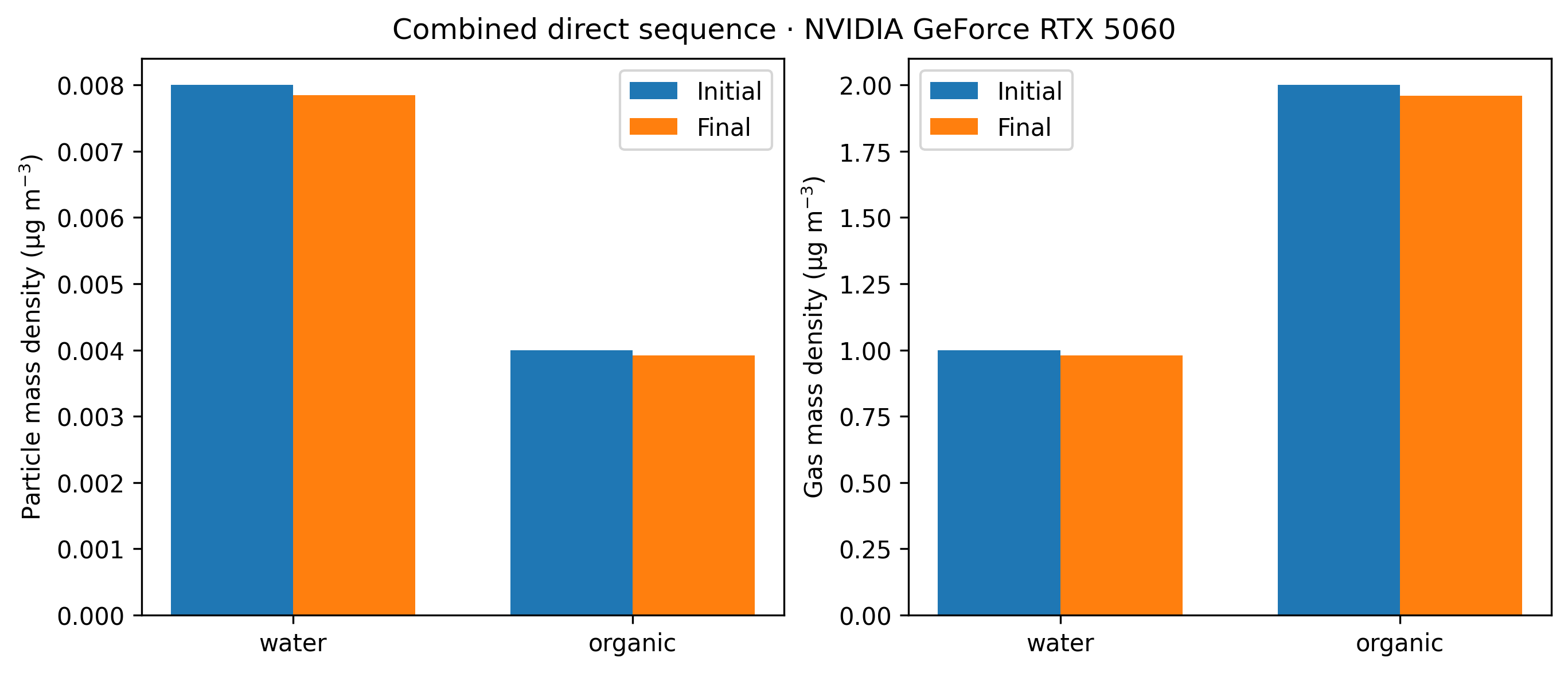
A sequence of calls is not a common physical timestep
Section titled “A sequence of calls is not a common physical timestep”Here condensation runs for 0.01 s, coagulation and wall loss for 1 s each, dilution for 0.1 s, and nucleation for zero time. The before/after panels therefore demonstrate composition of direct calls, not a synchronized chamber interval. Both species use illustrative constant vapor pressures of 10⁻¹² Pa.
The identity assertions check reuse of supplied storage; the plotted particle and gas changes do not independently validate every process budget. To attribute a response, observe inventories after each process and compare matched controls. For a continuous simulation, define a consistent splitting schedule and test its timestep and ordering. Continue with the prepared lifecycle, which supplies a per-process ledger and checkpoint continuation for an evolving population.
Explore this topic: Direct kernels