

The lucky few: growth, charging and background capture
Download Python script · Download script with helper and data files (.zip)
The lucky few: growth, charging and background capture
Section titled “The lucky few: growth, charging and background capture”The useful outcome is a defensible comparison of first-passage probabilities, including unresolved lineages and uncertainty. Work through ion-only balance first so that source and recombination errors are not mistaken for an effect on aerosol survival.
A large ensemble makes a rare survival fraction measurable. Each independent box begins with one neutral 3 nm seed and 32 neutral 100 nm background particles. The question is whether the original seed lineage reaches 50 nm before a background merger, under an imposed vapor feed and ion production of 0, 2 or 10 pairs cm⁻³ s⁻¹.
This is an illustrative competition between growth and scavenging, not a prediction for a measured atmosphere. A 50 nm threshold is a size proxy; the example does not calculate cloud activation. Charging is not assumed to help: it can also enhance scavenging by background particles.
Both omitted-rate assumptions are explicit sensitivity cases. The default workload uses 8192 independent boxes per case; numerical qualification is documented in the validation record. Each case starts with 270,336 aerosol particles and allocates 1,048,576 particle slots, including space for injected ions. The five cases execute sequentially on the GPU.
Use the Particula 0.3.0 development checkout with its prepared atmospheric-ion
API, plotting dependencies and a CUDA device. Download the helper ZIP and
run python example.py --cuda from its extracted directory. The plain Python
download also needs the helper files listed in the ZIP.
Python · section 1
"""Measure rare seed survival on CUDA under two explicit attachment assumptions."""
import argparsefrom dataclasses import replace
import matplotlib.pyplot as pltimport numpy as npimport warp as wpfrom scripts.gpu_studies.lucky_few import (    SurvivalConfig,    difference_interval,    run_survival,)
What is represented
Section titled “What is represented”The observation horizon is 20,000 s (5.56 h). Stepping stops earlier if every original lineage has reached the target or been captured: both outcomes are final. The displayed curves end at that diagnostic; later aerosol evolution is not simulated or inferred. Boxes are well mixed; particle positions and electric fields are not evolved. Each physical box occupies 3.2 × 10⁻¹⁰ m³; initial background concentration is 10¹¹ m⁻³. Increasing the number of boxes adds independent realizations without changing particle counts or physical volume within a box. Allocated slots are capacity, not particles. There are no statistical particle weights, resampling, adaptive volume changes, walls or dilution.
The five material lanes retain condensed vapor, original seed material, original background material, positive-ion mass and negative-ion mass. Effective ion masses are 150 and 90 u; both free ions have diameter 0.5 nm and charge ±1 e. Paired Poisson production adds both signs, with mean qVΔt. There are no free ions initially. Attachment changes aerosol charge by explicit mergers. Opposite free ions recombine at 1.7 × 10⁻¹² m³ s⁻¹; their neutral products are inert until periodic cleanup exports their mass. Same-sign free ions do not form stable clusters in this model. No additional bulk attachment or recombination sink is applied on top of these collisions.
Temperature and pressure are fixed at 298.15 K and 101325 Pa. The illustrative vapor has molar mass 0.2 kg/mol, diffusivity 5 × 10⁻⁶ m²/s, unit accommodation, reference vapor pressure 10⁻¹² Pa and surface tension 0.03 N/m. Condensation uses ideal molar activity and Kelvin density 1400 kg/m³. Vapor concentration is restored to 2 × 10⁻¹⁰ kg/m³ every 10 s: this is a pulsed external feed, not constant concentration between updates. Free ions and neutral products are excluded from condensation; aerosols with attached ions can still grow.
Growth is continuous deterministic condensation. Ion production and collisions are stochastic. Molecular stochastic growth and ion-induced nucleation are outside this model. Background particles also grow and coagulate, so they are not an immutable first-order sink.
Attachment uncertainty and the outcome definition
Section titled “Attachment uncertainty and the outcome definition”Aerosol–aerosol rates use the hard-sphere charged fit with Coulomb interactions. There is no additional image/polarization force between aerosols: at fixed masses and sizes, either zero aerosol charge removes the Coulomb correction. Ion–aerosol attachment uses LF2013 separately. The references motivate the question; reproducing their physical models would require matching their interaction laws.
LF2013 supplies ion–aerosol attachment within its tabulated charge, size and reference-condition domains. Some repulsive coefficients below 10⁻¹⁵ m³/s were omitted. A singly charged 3 nm seed falls outside the same-sign fit’s lower-radius limit. The library rejects these omissions by default.
lower replaces only these documented omissions by zero; upper replaces
them by 10⁻¹⁵ m³/s. Neither is an extrapolated best estimate. Running both is
a sensitivity comparison between two rate assumptions. Their survival
probabilities are not mathematically guaranteed lower and upper bounds:
charge history, growth and background capture interact nonlinearly.
Unsupported conditions outside the documented omission region still fail.
Each original lineage is classified once: reached 50 nm, captured by any
background merger before crossing, or unresolved at the observation horizon.
Background capture takes precedence if the merger itself creates a particle
above the threshold. Later scavenging does not undo an earlier success.
By default the order is ion injection, condensation, coagulation, then
cleanup. First passage is checked after physical processes; the ordering
resolves competing changes within that step, not their exact continuous
event times. Timestep and process-order sensitivity therefore matter.
The explicit coagulation_first control reverses the two aerosol processes
while retaining injection first and cleanup last.
Original lineage counts, not the changing number of aggregate particles, define the denominator. One initial seed per independent box allows exact binomial intervals; unresolved lineages remain visible rather than being dropped from the denominator.
Python · section 2
def run_example(config=None, policies=("lower", "upper")):    """Run the control and explicit attachment sensitivity cases.
    Defaults use the qualified study settings. Custom physical or numerical    settings need their own checks. ``policies`` selects one or both documented    omitted-rate assumptions.    The q=0 control is run once with strict lookup and no initial ions.    """    if config is None:        config = SurvivalConfig(boxes=8192, root_seed=321)    policies = tuple(policies)    if not policies or len(set(policies)) != len(policies):        raise ValueError("select distinct explicit omission policies")    if any(policy not in ("lower", "upper") for policy in policies):        raise ValueError("policies must contain lower and/or upper")    config.validate()    if not wp.is_cuda_available():        raise RuntimeError("This example requires CUDA; no CPU fallback")    print(f"Device: {wp.get_device('cuda:0').name}")    print(f"Configuration: {config}")    cases = [(0, "reject")]    cases.extend((q, policy) for q in (2, 10) for policy in policies)    results = []    for q, policy in cases:        current = replace(config, ion_pairs_cm3_s=q, omitted=policy)        result = run_survival(current, stop_when_resolved=True)        reached, captured, unresolved = result["outcomes"][-1]        low, high, zero_upper = result["success_interval95"]        print(            f"q={q} pairs cm^-3 s^-1, omitted={policy}: "            f"reached/captured/unresolved={reached}/{captured}/{unresolved}; "            f"success={reached / config.boxes:.5f}, "            f"exact 95% interval=[{low:.5f}, {high:.5f}]; "            f"maximum mass residual={result['maximum_mass_residual']:.2e}; "            f"observed peak slots={result['maximum_observed_slots']}/"            f"{config.capacity}; last simulated time={result['time'][-1]:g} s"        )        if zero_upper is not None:            print(f"Zero events: one-sided 95% upper bound={zero_upper:.5f}")        print(            f"Preparation/capture={result['preparation_seconds']:.3f} s; "            f"explicit gas forcing={result['forcing_seconds']:.3f} s; "            "synchronized stepping="            f"{result['synchronized_compute_seconds']:.3f} s"        )        results.append(result)    control = int(results[0]["outcomes"][-1, 0])    for result in results[1:]:        low, high = difference_interval(            control,            config.boxes,            int(result["outcomes"][-1, 0]),            config.boxes,        )        current = result["config"]        print(            f"q={current['ion_pairs_cm3_s']:g}, {current['omitted']}: "            "success probability minus no-ion control, conservative "            f"95% interval=[{low:.5f}, {high:.5f}]"        )    plot_results(results)    return results

def plot_results(results):    """Plot reduced lineage summaries; no particle states are downloaded."""    figure, axes = plt.subplots(1, 3, figsize=(14, 4), constrained_layout=True)    labels, final = [], []    for index, result in enumerate(results):        config = result["config"]        q, policy = config["ion_pairs_cm3_s"], config["omitted"]        coefficient = "0" if policy == "lower" else "10⁻¹⁵"        label = "No ions" if q == 0 else f"q={q:g}, K={coefficient}"        labels.append(label)        fractions = result["outcomes"] / config["boxes"]        final.append(fractions[-1])        low, high, _ = result["success_interval95"]        value = fractions[-1, 0]        axes[0].plot(result["time"] / 3600, fractions[:, 0], label=label)        axes[1].errorbar(            index,            value,            yerr=np.array([[value - low], [high - value]]),            fmt="o",            capsize=4,        )    final = np.asarray(final)    bottom = np.zeros(len(labels))    for index, name in enumerate(("Reached", "Captured", "Unresolved")):        axes[2].bar(labels, final[:, index], bottom=bottom, label=name)        bottom += final[:, index]    axes[0].set(xlabel="Time [h]", ylabel="Fraction reaching 50 nm")    axes[0].legend(title="Omitted K [m³/s]", fontsize=8, title_fontsize=8)    axes[1].set(        xticks=np.arange(len(labels)),        xticklabels=labels,        ylabel="Success fraction with exact 95% interval",    )    axes[2].set(ylabel="Fraction of original seed lineages", ylim=(0, 1))    axes[2].legend(fontsize=8)    for axis in axes[1:]:        axis.tick_params(axis="x", rotation=30)    return figure
Reading the result
Section titled “Reading the result”The curves show cumulative first passages; they are not instantaneous counts of surviving particles. Identical curves can overlap. Matching recorded outcomes under both rate assumptions does not establish identical survival probabilities. The final intervals quantify finite-ensemble sampling uncertainty for each case separately, not parameter uncertainty or a joint confidence band. Overlapping intervals alone do not establish equivalence. The printed differences compare each ion case with the no-ion control; each interval has its own coverage, not simultaneous coverage over all cases. A probability-difference interval and a declared tolerance are used for numerical qualification. A zero-success case gives an upper bound rather than proving survival impossible.
The runner checks each species’ mass inventory, including signed vapor feed, ion injection and exported neutral products; it also checks exact net charge and the reached/captured/unresolved partition in every box. Capacity exhaustion raises an error. Observed occupancy at diagnostic times is not a guaranteed instantaneous maximum between observations.
GPU value here is the scale of independent histories and repeated stochastic collision work. Report preparation and forcing separately from synchronized stepping. These timings exclude diagnostic transfers, plotting and analysis; a CPU speedup requires a matched CPU workload and is not inferred here. Numerical checks use a predeclared 0.01 absolute probability tolerance; they do not resolve effects smaller than one percentage point. The two attachment assumptions remain model uncertainty even after those checks.
Primary context:
- Gopalakrishnan and Hogan (2012): Coulombic collision scaling and the hard-sphere fit.
- Lehtinen et al. (2007), growth versus scavenging.
- Mahfouz and Donahue (2021), charge-enhanced scavenging can reduce survival.
- Olenius et al. (2018), stochastic effects on nanoparticle growth; this example uses continuous vapor growth, not their discrete growth model.
- López-Yglesias and Flagan (2013), ion attachment.
- Zauner-Wieczorek et al. (2022), ion–ion recombination.
- Yu (2010), ionization sensitivity, and Rose et al. (2013), observed ion sources and sinks.
- Clopper and Pearson (1934), exact binomial intervals.
Python · section 3
if __name__ == "__main__": parser = argparse.ArgumentParser(description=__doc__) parser.add_argument( "--cuda", action="store_true", help="CUDA execution is required for this study.", ) parser.add_argument( "--omitted", default="both", choices=("lower", "upper", "both") ) parser.add_argument("--boxes", type=int, default=8192) parser.add_argument("--time-step", type=float, default=1.0) parser.add_argument("--capacity", type=int, default=128) parser.add_argument("--cleanup-seconds", type=float, default=10.0) parser.add_argument("--root-seed", type=int, default=321) parser.add_argument("--coagulation-first", action="store_true") args = parser.parse_args() selected = ("lower", "upper") if args.omitted == "both" else (args.omitted,) run_example( SurvivalConfig( boxes=args.boxes, time_step=args.time_step, capacity=args.capacity, cleanup_seconds=args.cleanup_seconds, root_seed=args.root_seed, coagulation_first=args.coagulation_first, ), selected, )Explicit cuda invocation
result = run_example()Warp 1.11.1 initialized:
CUDA Toolkit 12.9, Driver 13.4
Devices:
"cpu" : "CPU"
"cuda:0" : "NVIDIA GeForce RTX 5060" (8 GiB, sm_120, mempool enabled)
Kernel cache:
/tmp/particula-charged-warp
Device: NVIDIA GeForce RTX 5060
Configuration: SurvivalConfig(boxes=8192, capacity=128, background_particles=32, box_volume=3.2e-10, seed_diameter=3e-09, background_diameter=1e-07, target_diameter=5e-08, material_density=1400.0, vapor_molar_mass=0.2, vapor_diffusion=5e-06, vapor_pressure=1e-12, vapor_concentration=2e-10, vapor_refresh_seconds=10.0, duration=20000.0, time_step=1.0, cleanup_seconds=10.0, ion_pairs_cm3_s=0.0, omitted='reject', root_seed=321, coagulation_first=False)Module particula.gpu.kernels.condensation 14a649a load on device 'cuda:0' took 1.51 ms (cached)
Module particula.gpu.kernels.condensation 2c7d291 load on device 'cuda:0' took 1.93 ms (cached)
Module particula.gpu.kernels.environment e11375e load on device 'cuda:0' took 1.97 ms (cached)
Module particula.gpu.kernels._condensation_native 34375de load on device 'cuda:0' took 1.56 ms (cached)Module particula.gpu.kernels.coagulation 907b9eb load on device 'cuda:0' took 1.13 ms (cached)
Module particula.gpu.kernels.coagulation 583acfc load on device 'cuda:0' took 1.75 ms (cached)
Module particula.gpu.kernels.coagulation 33bf240 load on device 'cuda:0' took 1.50 ms (cached)
Module particula.gpu.kernels.coagulation 5b8dfcc load on device 'cuda:0' took 1.25 ms (cached)
Module particula.gpu.kernels._coagulation_native f93a244 load on device 'cuda:0' took 1.66 ms (cached)
Module particula.gpu.kernels.cohort 2a4e654 load on device 'cuda:0' took 0.60 ms (cached)
Module particula.gpu.kernels.thermodynamics 563d292 load on device 'cuda:0' took 1.43 ms (cached)
Module particula.execution.prepared_guards e16d312 load on device 'cuda:0' took 1.62 ms (cached)
Module warp.utils f35afd3 load on device 'cuda:0' took 1.62 ms (cached)
Module warp.math edde159 load on device 'cuda:0' took 2.18 ms (cached)
Module warp.marching_cubes fb6e712 load on device 'cuda:0' took 1.16 ms (cached)
Module particula.execution.communication 2909959 load on device 'cuda:0' took 1.52 ms (cached)
Module particula.gpu.kernels._population_validation edde159 load on device 'cuda:0' took 2.19 ms (cached)
Module particula.gpu.kernels.communication ac9b2a2 load on device 'cuda:0' took 2.87 ms (cached)
Module particula.gpu.properties.gas_properties edde159 load on device 'cuda:0' took 2.20 ms (cached)
Module particula.gpu.properties.particle_properties edde159 load on device 'cuda:0' took 2.20 ms (cached)
Module particula.gpu.dynamics.coagulation_funcs edde159 load on device 'cuda:0' took 2.21 ms (cached)
Module particula.gpu.dynamics.condensation_funcs edde159 load on device 'cuda:0' took 2.20 ms (cached)
Module particula.gpu.kernels._condensation_parallel edde159 load on device 'cuda:0' took 2.20 ms (cached)
Module particula.gpu.kernels.exhaustion ccbadfa load on device 'cuda:0' took 2.04 ms (cached)
Module particula.gpu.kernels.slot_management 0375e2c load on device 'cuda:0' took 1.15 ms (cached)
Module particula.gpu.kernels.nucleation 1124f09 load on device 'cuda:0' took 3.10 ms (cached)
Module particula.execution.gpu_resources 30f296c load on device 'cuda:0' took 2.09 ms (cached)
Module particula.gpu.warp_types edde159 load on device 'cuda:0' took 2.20 ms (cached)
Module particula.execution.prepared_diagnostics ca06582 load on device 'cuda:0' took 1.93 ms (cached)
Module particula.gpu.kernels.ion_source b9167ba load on device 'cuda:0' took 1.58 ms (cached)
Module particula.gpu.dynamics.ion_pair_data edde159 load on device 'cuda:0' took 2.18 ms (cached)
Module particula.gpu.kernels._brownian_parallel 30c33a2 load on device 'cuda:0' took 2.40 ms (cached)Module particula.gpu.dynamics.ion_attachment edde159 load on device 'cuda:0' took 2.19 ms (cached)
Module particula.gpu.dynamics.mobility_attachment edde159 load on device 'cuda:0' took 2.19 ms (cached)
Module particula.gpu.kernels.ion_coagulation 1934680 load on device 'cuda:0' took 2.11 ms (cached)
Module particula.gpu.kernels.ion_cleanup 803bfea load on device 'cuda:0' took 1.78 ms (cached)
Module particula.gpu.kernels.condensation c7ee7df load on device 'cuda:0' took 2.34 ms (cached)
Module particula.gpu.kernels.condensation 57dfed0 load on device 'cuda:0' took 1.61 ms (cached)
Module particula.gpu.kernels.condensation 10a52cb load on device 'cuda:0' took 1.63 ms (cached)
Module particula.gpu.kernels._condensation_native 9623455 load on device 'cuda:0' took 3.72 ms (cached)
Module particula.gpu.kernels.condensation 67c2cff load on device 'cuda:0' took 1.93 ms (cached)
Module particula.gpu.kernels.ion_condensation 79e70b9 load on device 'cuda:0' took 2.02 ms (cached)
Module particula.gpu.kernels._condensation_native 76403ad load on device 'cuda:0' took 1.28 ms (cached)
Module particula.gpu.kernels.condensation ef85414 load on device 'cuda:0' took 1.90 ms (cached)
Module particula.gpu.kernels._condensation_native c295a4d load on device 'cuda:0' took 1.31 ms (cached)
Module particula.gpu.kernels._condensation_native a80ebff load on device 'cuda:0' took 0.88 ms (cached)
Module particula.gpu.kernels.condensation 79bc8cd load on device 'cuda:0' took 1.79 ms (cached)
Module particula.gpu.kernels.condensation 018e97e load on device 'cuda:0' took 1.66 ms (cached)
Module particula.gpu.kernels.condensation 4b067c1 load on device 'cuda:0' took 1.79 ms (cached)
Module particula.gpu.kernels._condensation_native ff4cf87 load on device 'cuda:0' took 4.47 ms (cached)
Module particula.gpu.kernels._brownian_parallel 6745116 load on device 'cuda:0' took 2.41 ms (cached)
Module particula.gpu.kernels.coagulation 54d7db3 load on device 'cuda:0' took 3.23 ms (cached)
Module particula.gpu.kernels.coagulation d9d6c48 load on device 'cuda:0' took 1.15 ms (cached)q=0 pairs cm^-3 s^-1, omitted=reject: reached/captured/unresolved=163/8029/0; success=0.01990, exact 95% interval=[0.01698, 0.02316]; maximum mass residual=2.89e-15; observed peak slots=33/128; last simulated time=3740 s
Preparation/capture=1.388 s; explicit gas forcing=0.312 s; synchronized stepping=401.142 sq=2 pairs cm^-3 s^-1, omitted=lower: reached/captured/unresolved=152/8040/0; success=0.01855, exact 95% interval=[0.01574, 0.02172]; maximum mass residual=2.89e-15; observed peak slots=35/128; last simulated time=3750 s
Preparation/capture=0.643 s; explicit gas forcing=0.293 s; synchronized stepping=402.694 sq=2 pairs cm^-3 s^-1, omitted=upper: reached/captured/unresolved=152/8040/0; success=0.01855, exact 95% interval=[0.01574, 0.02172]; maximum mass residual=2.89e-15; observed peak slots=35/128; last simulated time=3750 s
Preparation/capture=0.651 s; explicit gas forcing=0.286 s; synchronized stepping=403.026 sq=10 pairs cm^-3 s^-1, omitted=lower: reached/captured/unresolved=170/8022/0; success=0.02075, exact 95% interval=[0.01778, 0.02408]; maximum mass residual=2.89e-15; observed peak slots=37/128; last simulated time=3730 s
Preparation/capture=0.905 s; explicit gas forcing=0.306 s; synchronized stepping=403.518 sq=10 pairs cm^-3 s^-1, omitted=upper: reached/captured/unresolved=170/8022/0; success=0.02075, exact 95% interval=[0.01778, 0.02408]; maximum mass residual=2.89e-15; observed peak slots=37/128; last simulated time=3730 s
Preparation/capture=0.653 s; explicit gas forcing=0.296 s; synchronized stepping=403.466 s
q=2, lower: success probability minus no-ion control, conservative 95% interval=[-0.00827, 0.00559]
q=2, upper: success probability minus no-ion control, conservative 95% interval=[-0.00827, 0.00559]
q=10, lower: success probability minus no-ion control, conservative 95% interval=[-0.00626, 0.00797]
q=10, upper: success probability minus no-ion control, conservative 95% interval=[-0.00626, 0.00797]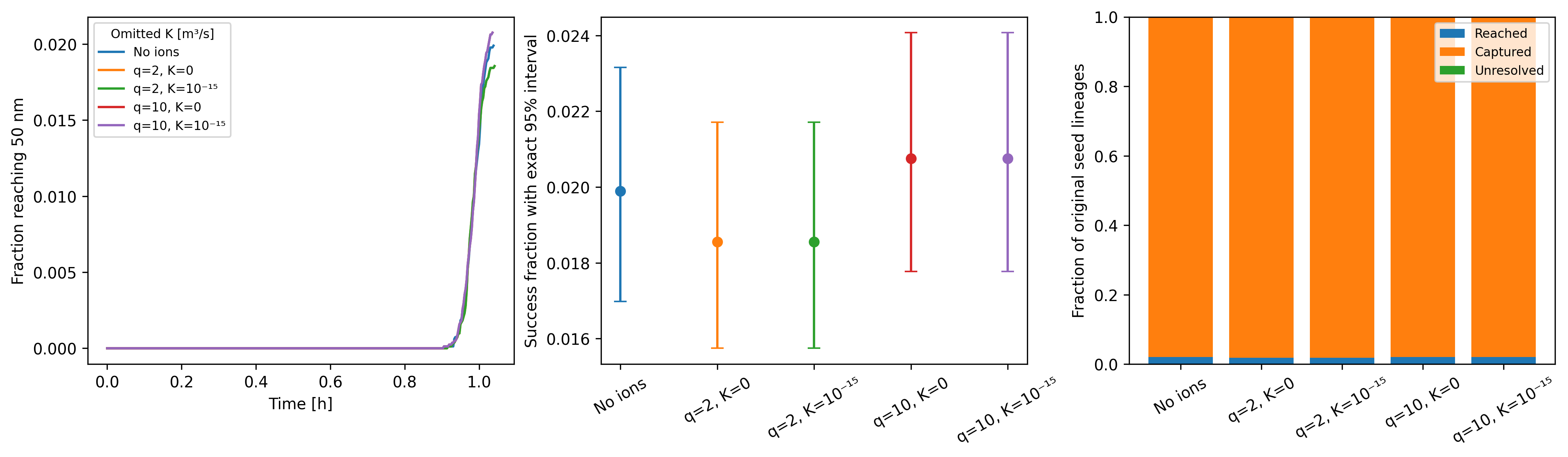
Ask which uncertainty limits the conclusion
Section titled “Ask which uncertainty limits the conclusion”The outcome partition answers whether an original seed reaches the size target before background capture under the stated model. It does not give the number of cloud-active particles remaining at a later time. A difference between ion cases must be interpreted alongside both finite-ensemble intervals and the two explicit attachment assumptions.
A concrete follow-up is to vary the vapor feed while retaining the background population and both omitted-rate policies. Compare success-minus-control intervals, unresolved fractions, and time-to-target distributions. Declare the smallest probability difference of scientific interest first, then choose enough independent boxes and numerical refinement to resolve it. An atmospheric claim would additionally require justified vapor, background, and attachment inputs; more GPU realizations cannot remove uncertainty in those assumptions.
Explore this topic: Atmospheric processes · GPU workflows · Charged particles and ions